

Some stories stick with us long after we’ve heard them. In The Lost Story of Via Belle, Harper and her mom enjoyed the novels written by author Via Belle. Seeing those novels again during a low point in her life causes Harper to want to learn more about the author and write a screenplay about the author’s life. It also starts Harper on a journey of self-discovery.
Melanie Dobson, the author of The Lost Story of Via Belle, was inspired to write this novel because of books she read growing up by author Grace Livingston Hill. Learn more about the book and how Melanie brought the characters to life in this Q&A. And hopefully the story of Via Belle will stay with you long after you’ve read it.
If you like what you read, get access to the entire first chapter of The Lost Story of Via Belle. Or find your own copy in softcover, e-book, or audiobook at a retailer near you.
What inspired this story?
Via Belle was inspired by the life of Grace Livingston Hill, a Christian novelist I used to binge-read as a tween. Grace wrote mysterious, romantic, and often historical novels that always, always had a happy ending. I wanted to be just like her when I grew up until I discovered her real life wasn’t nearly as romantic as her fiction. Grace experienced tremendous grief in marriage and was frequently criticized for writing inspirational stories during the rise of steamy pulp fiction, but she remained faithful to her calling, ultimately publishing more than a hundred novels. When she passed away in 1947, she was working on Mary Arden. Her daughter Ruth finished that final novel.
Once I became a novelist, I wanted to write a book inspired by the turmoil, loss, and redemption in Grace’s personal story. After visiting her home and writing space in Pennsylvania, my idea grew into a dual-timeline mystery about a novelist named Via Belle who slowly realizes, after marrying her second husband, that she’s been manipulated into a dangerous scheme. Sixty years after she disappears, a screenwriter named Harper determines to find out what happened to Via Belle and her last story.
What messages or themes do you focus on in this book?
As I wrote this book, I wrestled through the question of: What is truth and how is it manipulated today? With social media, photo editing, and the rise of generative AI, our culture has become masterful at creating illusion. Facades. It’s easy to look perfect through a camera lens, but much of what we see online doesn’t reflect the reality of what’s happening off-screen.
The Lost Story of Via Belle is ultimately a novel about betrayal and reconciliation as the main characters try to unravel and escape the antagonist’s conspiracy. In the end, I hope readers will be encouraged that none of us are alone in our struggles or failures, including those times we’ve been deceived. And we all need a little grace.
What about this book excited you while writing it, and what do you hope readers will learn?
I identified deeply with both of my main characters and their shared love for stories and writing. It was pure joy to capture some of this passion through their unique perspectives, in two completely different eras. I enjoyed the mystery and setting, particularly the moonflower garden and cemetery near Ashe Lake. I loved walking with Via as she struggled to rediscover her words and the friendship between Harper and Kelsey. And Finn was so fun to write—one of the good guys, as the women liked to say.
As Harper works on adapting Via’s life into a screenplay, she concludes: “The best way to honor a storyteller is to tell her story.” When readers finish this book, I hope they will ask how they can honor others as well, especially during life’s most difficult seasons. How can we use story for good?

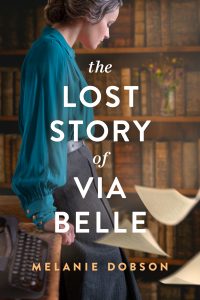
The Lost Story of Via Belle by Melanie Dobson
1940. Via Belle’s sweet romance novels made readers believe in happily ever after. But Via’s reality was much more complicated. While her first husband was alive, her creativity thrived in a beautiful stone estate situated above a pristine lake and moonflower garden. After his tragic death and a whirlwind second marriage shrouded in secrets, Via vanished from public life, leaving behind a shadow of scandal . . . and her final story.
2006. Screenwriter Harper Rayne is desperate for a breakthrough, if only she can find the right story to tell. But when she digs into the life of her late mother’s favorite novelist, she never expects it to become personal. Drawn to the quaint Pennsylvania town where both her mother and Via once lived, Harper discovers more than a mystery to solve—she finds echoes of her own longing for love, healing, and home. As long-buried secrets come to light, Harper must decide if she’ll protect the past or rewrite this particular ending.

Melanie Dobson is the award-winning author of almost thirty historical, time-slip, and romantic suspense novels. Five of her novels have won Carol Awards; Catching the Wind and Memories of Glass were nominated for a Christy Award in the historical fiction category; and Catching the Wind won an Audie Award in the inspirational fiction category. The Black Cloister, her novel about a religious cult, won the Foreword Religious Fiction Book of the Year.
Melanie is the previous publicity manager at Focus on the Family and owner of the publicity firm Dobson Media Group. When she isn’t working on her next novel, Melanie enjoys hosting a monthly writer’s group and teaching as an adjunct professor at Corban University.
After moving numerous times, Melanie and her husband, Jon, have settled near Portland, Oregon, and they love to explore the mountains and waterways of the Pacific Northwest.
Now that her two daughters have launched into adulthood, Melanie enjoys kayaking on the weekends, playing with her little grand guy in Virginia, and visiting locations around the world to research her next novel.
Visit Melanie online at melaniedobson.com for more information about her books or to sign up for her newsletter.