
In the historical novel Every Given Day, Cathy Gohlke explores how the Spanish flu epidemic and a diabetes diagnosis would have affected the lives of everyday people in 1918.
This novel started with a personal connection to Cathy’s family, which led her down the path of research where she developed the storylines that would eventually become Every Given Day.
Continue reading to find out what family connection influenced Cathy and what she found out over the course of her research to create this gripping novel.
If you like what you read, get access to the entire first chapter of Every Given Day. Or find your own copy in softcover, e-book, or audiobook at a retailer near you.
There’s something magical about the search for historic details. It’s a treasure hunt for hidden gems, nuggets of gold, and whisps of fairy dust, sometimes found amid ancient ruins, forgotten diaries, or dusty tomes. At least that’s what I’ve long found and imagined once more when I began unearthing details from the Great War and early 1920s for my new release, Every Given Day.
This story was inspired by my eight-year-old granddaughter’s unexpected onset of Type 1 diabetes following a serious bout with COVID and a viral infection in 2020. Public precautions and treatment of COVID in the early 2020s was so similar to the precautions and public treatment of the Spanish influenza a hundred years earlier that I could not help but be intrigued and follow that long-ago rabbit trail.
Imagine my shock in learning that after the Spanish influenza, just as after COVID, there was a rise in juvenile diabetes. That revelation led me deeper into the years following the Great War and the ultimate discovery of insulin— medicine that amended the death sentence for those diagnosed with diabetes, known as the wasting disease for the way it wasted the body away to nothing, usually within two to three years.
What I learned about those years—1918-1923—captivated me. It was a time when the world, and certainly America, longed to put the dark years of the Great War and the flu that ravaged families, killing millions across the world, behind them. It was the coming of age for a generation known as “the lost generation” and conversely as the “generation of flappers and jazz.” It marked a season of renewed hope and energy, of optimism, of excess. It was the era of Prohibition and speakeasies, creating the rise of gangs and gangsters seeking to outwit and profit from illegal sales of liquor and ultimately of drugs. The early 1920s saw new inventions, dramatic changes in fashion, struggles and victories for the rights and roles of women, the breaking down of social mores, frenzied research, and great scientific and archeological discoveries, including the discovery of King Tut’s tomb in Egypt.
Many of those changes and some of those great discoveries feature in Every Given Day. Surely the most exciting and lifesaving was the discovery and purification of insulin.
Dr. Frederick Banting, a Canadian surgeon working long and diligently with medical student Charles Best at the University of Toronto under Dr. Macleod, first isolated the hormone insulin in 1921. But the insulin wasn’t pure, wasn’t stable, doctors had no idea of the correct dosage or how that differed from person to person, and they had no way to make it in quantity or commercially available. Children continued to die. James Collip joined the team and helped to purify the pancreatic extract.
In 1922, Dr. Banting and others at the Toronto General Hospital rushed the purified extract to a ward of mostly comatose children—children dying from diabetic keto-acidosis. Desperate but daring to hope, they rapidly injected the children with the new and purified extract of insulin. By the time they injected the last child, the eyes of the first child to be injected fluttered open. One by one the children woke from their comas. Each time I read of that momentous scene I think, it must have been like watching a resurrection! Death hovered menacingly at the door, but insulin threw it wide open, and life walked in.
Dr. Frederick Banting, Dr. James Collip, and Charles Best sold the patent for insulin to the University of Toronto for $1.00. Dr. Banting declared, “Insulin does not belong to me, it belongs to the world.”
This momentous discovery and the selfless act of these men for the good of others inspired the historic line of my story. For their determined work my family and I will be forever grateful.
Researching the past often leads to thrilling discoveries. They make writing and reading historical fiction a delight. I hope as you read Every Given Day you, too, will discover gems and be inspired.

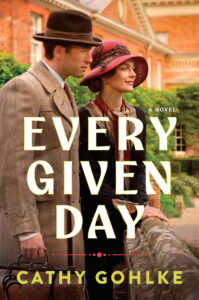
Every Given Day by Cathy Gohlke
New York City, 1918. When schoolteacher Gwendolyn Armstrong learns of her sister’s worsening illness, she travels to Marion’s stately home to tutor her young niece and nephew, kept from school by the Spanish flu outbreak. Though the family lives in luxury, Gwen is wary of Marion’s sophisticated, often-absent husband, Russell, who once cast Gwen aside for her sister, leaving wounds that never fully healed.
As Marion’s health declines, a sense of foreboding settles over the family. Gwen observes strangers coming and going from Russell’s study at all hours, and her lingering distrust turns to suspicion that he is hiding something that could threaten the family’s safety and security. But when the deadly flu claims victims among the family and mansion staff, Gwen and her nephew, Alistair, are forced to accept terrible losses caused by the epidemic followed soon after by his own fatal diagnosis of juvenile diabetes.
When a compassionate doctor becomes both an advocate and friend, chasing down every promising medical development in the race for a cure, Gwen clings to each shred of hope. But as Russell’s clandestine dealings erupt into a shattering revelation, she must summon every ounce of courage she possesses. With Alistair’s life hanging in the balance, Gwen pleads for a faith she doesn’t yet possess, realizing she must surrender him to God and the possibility of a miracle that could save him and reshape her future in ways she never imagined.

Bestselling, Christy Hall of Fame, and Carol and INSPY Award–winning author Cathy Gohlke writes novels steeped with inspirational lessons, speaking of world and life events through the lens of history. She champions the battle against oppression, celebrating the freedom found in Christ. Cathy has worked as a school librarian, drama director, and director of children’s and education ministries. When not traveling to historic sites for research, she and her husband, Dan, divide their time between northern Virginia and the Jersey Shore, enjoying time with their grown children and grandchildren. Visit her website at cathygohlke.com and find her on Facebook at CathyGohlkeBooks and BookBub at @CathyGohlke. Cathy welcomes invitations to virtual book club meetings through the Connect page of her website.