

In the Southern historical novel The Dogwood Gospel, author Cindy Morgan tells the story of teenaged Charlie. When Charlie runs away from the constricting couple raising her as her own, she works as a trick-horse rider at the Southland Carnival. There, she creates her own version of family among the carnival’s kindhearted misfits and wounded souls. Charlie’s disappearance, however, triggers an investigation that brings to light secrets from a cold case.
In this guest post, Cindy explains how she was able to combine a coming-of-age story with a cold-case mystery, as well as the background for Charlie’s character. Cindy also explains what she hopes readers will take away from the found-family trope woven throughout the novel.
If you like what you read, get access to the entire first chapter of The Dogwood Gospel. Or find your own copy in softcover, e-book, or audiobook at a retailer near you.
Your story blends coming of age with mystery. What drew you to intertwine Charlie’s personal journey with a darker, suspenseful storyline?
I’ve always been a fan of books that combine good character development with a plot that keeps the story moving forward. Charlie’s story has so many unanswered questions which needed investigating. I lived next door to a police officer and investigator for ten years. He was the inspiration for Chief Cates. I enjoyed diving into his world on Charlie’s behalf.
What does the world of the traveling carnival represent for Charlie, and why was it the right backdrop for this story?
Charlie doesn’t belong anywhere, with the exception of maybe her relationship to Bobby and also to Fiona. She has too many unanswered questions to ever feel like she can move on with her life without second-guessing herself. Many people live their lives feeling like they don’t belong, which often leads to a feeling of isolation, desperation, and poor decisions. In the heyday of the big railroad carnival, the main attraction was often the outcasts of normal society, but these outcasts found a sense of belonging among each other in the world of the Southland Carnival. I had a feeling Charlie would find a home there, and of course, get some answers.
Charlie spends much of the novel hiding her identity. How did you approach writing her internal struggle between safety and authenticity?
Fear is an incredible motivator. So is anger. I have never lived in a scenario where I felt that I had no choice in the decisions for my own life. But that was what Charlie faced with Arlo’s dominance and Rose’s chosen helplessness. I think Charlie’s desperation for independence (which I very much relate to) would have made it worth hiding her identity for the sake of ultimately getting her freedom. I don’t think she was resentful of having to hide her identity. I think she always knew the point of why she was doing that and that it would ultimately lead to her independence.
Found family plays a powerful role in the book. What do you hope readers take away about belonging and the idea of “home”?
“Found family” is a term I love. Growing up in a close-knit Southern family, I think the blood family was held up, almost religiously, but as I have travelled and heard so many stories from people’s lives—many people find their only safe option is to escape their family, or at the very least, create healthy boundaries when family members are unsafe. Found family is a very important part of how we survive and thrive in the world. Sometimes it’s easier to grow and mature without someone who knows all of your baggage hovering at your shoulder and making you stay in the mold they would like to keep you in. But in a healthy family, no one is more loyal or comforting than those who know everything about you and your story and accept and love you no matter what. Home is where you are surrounded by those who understand you and love you for all that are—good and bad.
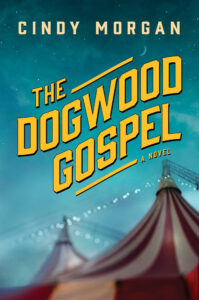
The Dogwood Gospel by Cindy Morgan
Kentucky, 1954. Sixteen-year-old Charlie has no memory of being abandoned as a toddler—only the life she’s known with Mama Rose and Arlo, the rigidly devout couple who raised her as their own. But when Arlo’s rules begin pressing tighter by the day, and Mama Rose reveals a long-buried secret, Charlie realizes the truth of her past lies elsewhere. So she runs.
Disguised as a boy and dreaming of a future beyond the hills, Charlie follows the Ohio River to the Southland Carnival, where her fiery red curls and daring trick-riding skills catch the owner’s eye, and Charlie is transformed into a featured act. As “The Irish Princess,” she soars beneath the Big Top, thrilling crowds and finding family among the carnival’s kindhearted misfits and wounded souls.
Back in the hills of rural Kentucky, police chief Curtis Cates has his hands full with the disappearance of three local girls when he receives the call that Charlie has gone missing. As he begins investigating, the evidence leads in a shocking direction, calling to mind an unsolved murder that has haunted him for thirteen years. When the trail takes him to the Southland Carnival, Charlie’s hard-won freedom collides with the secrets she fled, forcing both of them to face truths that have waited too long to be told.

Cindy Morgan is a Nashville-based singer-songwriter and author. Her debut novel, The Year of Jubilee, was nominated for a Christy Award in General Fiction and an Audie Award for its audiobook performance. She is also the recipient of the prestigious Songwriter of the Year honor and the 2024 Hollywood Independent Music Award for her single “Jubilee,” featuring Tommy Sims, from the companion soundtrack The Sounds of Jubilee.
Morgan is a two-time Grammy nominee and a fourteen-time Dove Award winner—including the 2023 Inspirational Album of the Year for her work as a producer. She also received a 2024 Music in Media Award nomination for Documentary Song of the Year for “Pain Has a Purpose.” With twenty-one number-one radio singles, she has written songs for an extensive list of artists, including Amy Grant, Vince Gill, Sierra Hull, Sandra McCracken, India.Arie, Rachael Lampa, Rascal Flatts, Echosmith, Ricky Skaggs, Glen Campbell, Mandisa, Natalie Grant, and many others.
Morgan is the cocreator of the charitable Hymns for Hunger Tour with longtime collaborator Andrew Greer, raising awareness and support for hunger relief organizations worldwide. For the past decade, she has partnered with Operation Song, which pairs professional songwriters with veterans navigating PTSD to help them process their stories through music. Most recently, Morgan has collaborated with City Gate and Hope in the Gate, writing songs that give voice to the stories of unhoused individuals across America. She also recently hosted her first annual songwriting intensive, The Troubadour Storyteller’s Retreat, alongside her daughters, Cova Gentry and Savannah Shepherd, who are also writers.
Morgan is married to Jonathan, an attorney and songwriter.
For more information visit cindymorganmusic.com.