A Strong and Trustworthy Anchor for Our Souls

by Kim Adetunji, Tyndale Bibles Brand Manager

It’s beginning to look a lot like Christmas. Or at least a little. We’ve already had our first snowfall in Chicago, and with mixed emotions, have begun bracing ourselves for the wintery season ahead. Thanksgiving and Christmas are just around the corner, and the holiday season is upon us. Soon we will gather with friends and family to celebrate our gratefulness to God for the blessings in our lives—both grand and small. Then next month loved ones will gather again to celebrate the joy of Christ’s birth, and a week after that we will celebrate the closing of one calendar year and the promise and hope of the new one. It is indeed a wonderful time of the year.

And yet, along with all of the blessings and joy and celebration, many of us are also harboring heartache deep within. We may be going through a very difficult season of life or have recently lost a loved one. It could be that our circumstances aren’t what we’d hoped they would be. Or maybe we are suffering from debilitating depression. Perhaps a relationship desperately needs mending or one has just been painfully severed. These—and so many other heartaches—leave a gap in our hearts, and the ache is palpable.

Yet there is hope in the midst of our heartache. Our hope comes from a powerful God who not only created us but who knows us intimately. He is present with us. He is our comforter. He loves us perfectly. We never have to doubt God’s sovereignty or whether he is in control or if he is good. He is. And he will sustain us through whatever we face.

Over the holidays, there seems to be a keener awareness of the loss, hardships, grief, health battles, financial difficulties, troubled relationships, and other heartaches in our lives. We often long for simpler times—before these difficult realities entered the scene. As we enter into a season of reflection, this can draw a myriad of emotions to the surface. No matter what happened in the previous year or what lies ahead in 2019, each new day is an opportunity for us to put our trust ever more fully in God.

We can choose to embrace all that God has for us in this very moment. It’s certainly a choice. We could harbor resentment or anger in our hearts, or we could stubbornly refuse to turn to God through it, or we could try to numb it with our favorite “numbing” mechanism. It would be a whole lot easier to suppress it, at least in the short term. But why? God is trustworthy. We can open our hearts fully to him and offer him our pain, unknowns, uncertainty, loss, and troubles—all while recognizing the gifts and blessings and favor he has bestowed upon us. We can live in those two realities—joy and heartache—simultaneously. We may not know what tomorrow holds, and we often can’t see the purpose in the pain, but when we hang on to the truth that hope is not lost—that it is real, and present, and available—despite even the worst of circumstances, we can rest in that assurance.

Though the ache may linger, hope is an anchor. We can let hope be the strong and trustworthy anchor for our souls, as Scripture says. It’s not just lip service. It’s the Word of God. Our loving father in heaven knows our hearts—all the valor and all the murkiness that lurks within. He sees each tear that falls, and he hears our deepest heart’s cry even when it is unspoken. Trust him in the midst of whatever storm you are being thrown about in. Draw on the eternal hope that surpasses all understanding.

“Therefore, we who have fled to him for refuge can have great confidence as we hold to the hope that lies before us. This hope is a strong and trustworthy anchor for our souls. It leads us through the curtain into God’s inner sanctuary. Jesus has already gone in there for us. He has become our eternal High Priest in the order of Melchizedek” (Hebrews 6:18-20).

Let that sink in: This hope is a strong and trustworthy anchor for our souls. An anchor that holds strong through the storm that rages. An anchor that steadies. May you weather the wintery days of your soul with as much beauty and hope and joy and trust as you have on the summery blue skies days of your soul.

Your Bible is already the place you turn to daily for a word from God. Why not record all that you are learning and how you are growing or being challenged or are seeing God’s love and faithfulness in your life in your Bible? You read it consistently—or you strive to—and what better place to capture your faith journey than in a soon-to-be-cherished legacy Bible. If you’re looking for something new to refresh your Bible-reading in 2019, consider getting a New Living Translation journaling Bible.


A Life of Thanksgiving

Shout with joy to the Lord, all the earth!

Worship the Lord with gladness.

Come before him, singing with joy.

Acknowledge that the Lord is God!

He made us, and we are his.

We are his people, the sheep of his pasture.

Enter his gates with thanksgiving;

go into his courts with praise.

Give thanks to him and praise his name.

For the Lord is good.

His unfailing love continues forever,

and his faithfulness continues to each generation.

Psalm 100, NLT


Through three simple steps, Psalm 100 gives us a model for how to be more thankful. First, “come” (100:2). This is our invitation, the assurance that we are welcome, which needs a response. We have to choose not to stay in our present feelings but fix our thoughts on God. Second, “acknowledge” (100:3). This is a provocation to forget about ourselves and focus on God as we remember all that he has done for us. Third, “give thanks” (100:4). As we recall what he has done for us, it becomes easy to be thankful.

Here are some of the things the psalmists encourage us to thank God for:

  • His creation (Psalm 104:1-30)
  • His care of us (Psalm 95:6-7)
  • His knowledge of us (Psalm 139:13-16)
  • His salvation (Psalm 27:1-14)
  • His answering of our prayers (Psalm 118:21)
  • His provision (Psalm 147:7-9)
  • His healing (Psalm 30:1-2)
  • His rescue (Psalm 31:21-22)
  • His victory (Psalm 118:10-16)

Thanksgiving needs to become a way of life for us. As Paul wrote, “Always be joyful. Never stop praying. Be thankful in all circumstances” (1 Thessalonians 5:16-18).

Taken from the Christian Basics Bible. Take a look inside


Promised Land

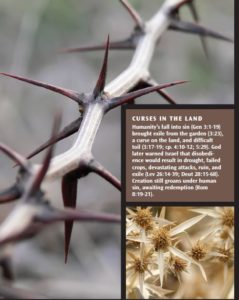
Men and women were given the task of subduing the earth and ruling over the creation, both to satisfy their own needs and to bring glory to the Creator (Gen 1:28-30). But when humanity fell into sin, they suffered alienation not only from God and their fellow human beings but also from the land on which they lived (3:15-19; see 4:3-16; cp. 5:29).

Then God called Abram to follow him by faith and to receive Canaan as a special homeland, a promised land for his descendants as God’s people (12:1-3, 7; 13:14-18; 15:7-21; 17:7-8). Later, Israel was delivered from Egypt, established as God’s people at Mount Sinai, and given possession of the land promised to their fathers.

Continued possession of the land depended on obedience. If Israel violated the covenant, they would experience the covenant’s curses, the most severe of which is exile from the Promised Land (Lev 26:32-33). Eventually, that is what happened: Israel’s persistent rebellion against the Lord resulted in their exile to Assyria and Babylon, the loss of the land, and the destruction of the Temple (2 Kgs 17:5-23; 25:1-21). But God also promises that when the people repent, “then I will remember my covenant with Jacob . . . and I will remember the land” (Lev 26:42). During the exile, Jeremiah and other prophets looked beyond the exile to a future restoration and return to the land (Jer 32:36-44), which occurred during the reign of Cyrus the Great of Persia (see Ezra; Nehemiah).

The promises for the land await ultimate fulfillment. God’s purpose is to prepare an eternal homeland for his people, where the rule of the divine King is direct and just, where all things are subject to his will, where death and sin are abolished, and where the needs of his people are completely satisfied (Heb 11:13-16; Rev 21).

Taken from the Illustrated Study Bible

Take a look inside the Illustrated Study Bible

How Do I Use the Filament Bible?

Filament combines the simple elegance of a premium text Bible with the powerful capabilities of your mobile device. You get the best reading experience a print Bible can offer and instant access to more meaningful content than you’ll find in any one study Bible or devotional Bible. But for the many the question is how does it work? Dan from Tyndale House Publishers takes you through the process and shows you how all the different levels of content and engagement can help you go deeper into what God is saying to you through His Word. Click on the screen shot for the video and if you have additional questions click on the link to our FAQs page.

Have more questions? Check out our FAQs page.

Wayfinding Journey to My Favorite Bible

We love hearing how our Bibles are bringing people closer to God. When we came across this writer and podcaster’s posts about The Wayfinding Bible, we were so excited. Wendy has graciously agreed to share why she loves this Bible and how it has helped her and her family go deeper into God’s Word. Thanks, Wendy! You can follow her on Instagram, Facebook, and Twitter (@mrswendyjolson)

By Wendy J. Olson

I might be an awful person: I judge a book by its cover.

No, literally. When I buy a book, I decide if I will like it based on what the cover looks like. I’ve literally not read a great recommendation because I thought the cover was weird. It gave me the creeps. I’m usually spot on about these things too. Good cover, good book. I believe my logic to be sound.

So when I went in search of a new Bible several years back, I did just that. I looked at all the Bibles, compared covers, and made my decision based around some guidelines. First and foremost, I wanted a leather-bound Bible. It had to be wiggly—nothing is worse than a stiff Bible. I also wanted something I could actually read and write in the margins. I’m a big doodler. I like to take notes and even write the date in the margins of when I learned something. Sometimes I will even write where I heard it or who I heard it from. From year to year it helps me see what I’ve learned and how my faith is being shaped and is evolving.

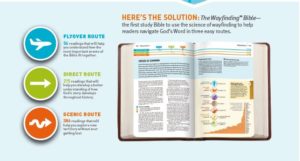
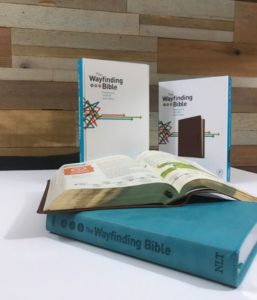
Several hours on the floor of a Lifeway and mild mumblings to myself later, I finally settled on The Wayfinding Bible. Not only did I find the format to be most useful for my taste, but I liked that it had different “read-through” options. I should probably note here that I have never actually done any of these reading plans, but I still like having the options.

I don’t know about you guys, but I’ve always been the person scratching my head when someone says, “The Bible is clear.” Maybe I’m the only one, but the Bible has never been so black and white to me. I’ve noticed the more I read, the more I dig in and learn and feed my spiritual beast, the more perplexed I can find myself. Sometimes I just need plain English! This is the exact reason I purchased an NLT version. I was brought up in a small Southern Baptist church where nothing but NIV and NKJV were acceptable. God love ’em. It wasn’t until I heard my good friend speak and read from her NLT version that I was like, “Yessss! I need me some of that!”

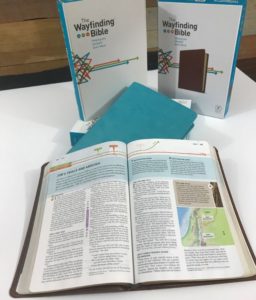
Not only is The Wayfinding Bible in the New Living Translation, but it also has excerpts every few pages that go into more detail about what the Bible is saying, which I love. There is a brief description about the part of the story they are talking about; then an Observation Point, which gives a little bit of history and background for you; and finally an Exploration Point, which gives you further insight and maybe even poses a question for you to ponder. This is one of my favorite features of The Wayfinding Bible because it really brings everything around full circle. My kids like reading these parts, and when I’m stumped on how to explain something so they might understand better, this gets me out of a jam.

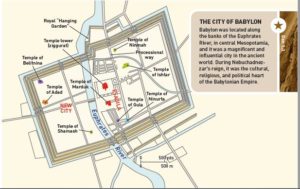
The Wayfinding Bible’s pages contain maps and historical references, including what it looks like there now, with geographical explanations of “where in the world” and pictures to help you visualize where you are in the story. They call these “Historical Markers” and mark them with stars throughout the text, and “Scenic Overlooks” are marked with binoculars.

Each book of the Bible contains “Book Introductions,” giving you the background and timeframe of the book, other events that happened surrounding the writing of the book, and a note about “Finding Jesus in . . .” each book. Book Introductions also map out the three “flight,” or reading, plans throughout each book of the Bible. I’ve learned a lot for myself with this feature. I love a little bit of history, but not too much, and figuring out what is happening when and where and to whom around the writing of each book. At the bottom of each Book Introduction is a timeline, showing you the year and, in the Old Testament, how far away you are from the birth of Jesus  or, in the New Testament, how far removed you are from his birth Sometimes we get lost in the logistics and shuffle in the Word and forget that the Bible isn’t written in chronological order. This helps recalibrate us and gives us a better sense of what each book means and what it meant to its readers over time. Eight times in The Wayfinding Bible you’ll find a “Getting Your Bearings” section where you can stop and get caught up on some history and geography as well as read some background stories that help tie it all together.

This may sound silly, but my two favorite things about this Bible are the layout and the fact that I can HIGHLIGHT in it!!! What!?!?! For years I was stuck with a Bible that was printed on such thin paper that I could spit through it or tear it so easily if my pencil was too sharp. The Wayfinding Bible is not such a Bible. This probably doesn’t seem like a big deal to most people, but to those of us who are serious about our studying and scouring and highlighting and . . . doodling, this is key! I have had this Bible for over four years now, and it has taken all I have handed it. Plainly, it has taken a beating. And it has survived, flawlessly.

And as for the layout, I like a Bible I can actually read, because I do . . . actually read it. I don’t like small print or weird margins or layouts. Nonetheless, I love the friendly layout of The Wayfinding Bible. It is friendly for my eyes and for my brain, and I need both of those to get along in order for me to comprehend anything.

So there it is, my favorite Bible thus far. Anytime I post a pic of my Bible, the internet goes crazy. People are craving something more friendly and useful because they are WANTING to read their Bibles, and this one delivers on all counts. I love it; my kids love it. If my house were to ever catch on fire, God forbid, I would grab my kids and my Bible. I read a post by a famous Christian speaker who said she packed her Bible in her checked baggage and it almost got lost. She said it felt like she had lost her child, and I know the feeling. If I lost this one, I would be heartbroken.

“If Found, Please Return and Reward WILL Be Given!”

I don’t think I’ve ever been attached to a Bible like this before, and I don’t think I will ever again. This is it for me. The only way it could be better is if the NLT and The Message versions had a baby and birthed it in this Bible edition. Who do we talk to about that?

Take a look inside the Wayfinding Bible

Grant R. Osborne, 1942-2018

brian

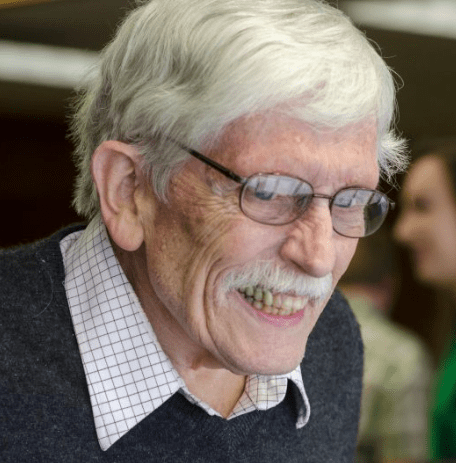
Tyndale House Publishers is saddened by the death of Grant R. Osborne—our friend, colleague, and a member of the Bible Translation Committee for the Holy Bible, New Living Translation (NLT). But we do not grieve as those who have no hope. We rejoice with Grant that he is now in the presence of his Savior.


Grant was a member of Tyndale’s Bible Translation Committee (BTC) from the very outset in 1987. He served as General Translator for the Gospels and Acts. In that role he coordinated the work of five teams of scholars—one for each of the books in his section of the NLT translation. Each member of the BTC carefully reviewed every word in the entire translation. And because of the back-and-forth nature of the translation and review process, Grant read every word of the entire translation multiple times. Like all of his colleagues on the BTC, he made an enormous contribution to the church worldwide through his work as a translator of the NLT.

I remember many times when a small committee would be working on the wording of one of the Gospels or the Acts of the Apostles. Our goal was to render the meaning of the Greek text into everyday English. But sometimes we could get stuck on how best to understand the Greek text. We would turn to Grant and ask, “What does this text really mean? Will the average K-Mart shopper understand what this passage means?” Then Grant would give us a brief oral exposition on the meaning of the text, and we would scramble to capture it in everyday English. Grant had a gift for understanding the Greek text and helping to present it in modern English.

Grant was a professor of New Testament at Trinity Evangelical Divinity School. He taught at TEDS from 1972 until his retirement several years ago. He is eulogized very warmly by his former colleague Dr. Scot McKnight on the Patheos website.

The Lord’s Prayer

brian

I write this on a Sunday afternoon. In the church service this morning we recited The Lord’s Prayer, as we do most Sundays. But why are there so many variations in how different churches use this prayer? Here is one traditional form that is used in many Protestant churches. It is taken from the 1928 edition of The Book of Common Prayer, which is similar (but not identical) to the wording of Matthew 6:9-13 in the King James Version:

Our Father, who art in heaven,
Hallowed be thy name.
Thy kingdom come.
Thy will be done,
On earth as it is in heaven.
Give us this day our daily bread.
And forgive us our trespasses,
As we forgive those who trespass against us.
And lead us not into temptation,
But deliver us from evil.
For thine is the kingdom, and the power, and the glory,
For ever and ever. Amen

We’ve probably all stumbled over “trespasses” versus “debts.” The difference arises because The Book of Common Prayer uses “trespasses,” but the KJV reads, “And forgive us our debts, as we forgive our debtors.” So different churches use one or the other of those formats.

But many churches use the NIV or the NRSV or the NLT or the ESV or the NKJV as their standard text. Those translations each translate the original Greek text of the prayer with slight variations in English wording. And the UBS Greek text—which is the base used by most modern translations—does not include the last sentence of the prayer. Accordingly, the RSV, NIV, NRSV, NLT, and ESV include the last sentence only in a footnote.

Where there is a multiplicity of options, many churches simply use the traditional language of the Lord’s Prayer, including the archaic pronouns thy and thine. My church, which uses ESV as the standard preaching text, has adopted the ESV format of the prayer for use in public worship, though we add the last sentence as in the traditional formats of the prayer:

Our Father in heaven,
hallowed be your name.
Your kingdom come,
your will be done,
        on earth as it is in heaven.
Give us this day our daily bread.
And forgive us our debts,
        as we also have forgiven our debtors.
And lead us not into temptation,
        but deliver us from evil.
For yours is the kingdom, and the power, and the glory, forever. Amen

I must admit, I still stumble occasionally over the phrase “as we also have forgiven our debtors.” But even old dogs can learn new tricks if they put their minds to it. And since this blog is oriented primarily to the NLT, I will now reproduce the prayer as it is found in Matt 6:9-13 in the NLT:

Our Father in heaven,
        may your name be kept holy.
10May your Kingdom come soon.
May your will be done on earth,
        as it is in heaven.
11Give us today the food we need,*
12and forgive us our sins,
        as we have forgiven those who sin against us.
13And don’t let us yield to temptation,*
        but rescue us from the evil one.*
            6:11 Or Give us today our food for the day; or Give us today our food for tomorrow.
            6:13a Or And keep us from being tested.
            6:13b Or from evil. Some manuscripts add For yours is the kingdom and the power and the glory forever. Amen.

I should also mention the Latin edition, which is still used by many Catholics. It is often called “The Pater Noster,” since the first two words of the prayer are Pater noster (“Our Father”). But in most English-speaking Catholic churches, the Lord’s Prayer is recited in English with wording identical to that found in The Book of Common Prayer, but without the doxology at the end.

Fascinating!

Reader Question: Throwing Pearls to Swine (Matthew 7:6)

A reader asks: “We hear a lot about Matthew 7:1-5 regarding a log in your eye, but not much about verse 6. What is that talking about and how does it relate to the earlier verses?” Mark D. Taylor, CEO of Tyndale House Publishers and Director and Chief Stylist for the New Living Translation Bible Translation Committee, agreed to share his thoughts on this topic.

Good questions! Let’s take a look.

First of all, the series of teachings in Matthew 5-7 is often called the Sermon on the Mount. But the text in this extended section probably does not reflect everything Jesus said at that time. Rather, Matthew has organized it as a series of teachings on various topics. Any specific topic does not necessarily relate to the topics before or after it.

For example, the pericope (short section) in 7:1-5 relates to the hypocrisy of judging others when we have sin in our own lives. And isn’t the metaphor of a log in the eye wonderfully descriptive?!

Then we find the pericope (7:6) about throwing pearls to pigs. How does it relate to the previous verses? Scholars have differing opinions on that issue. My perspective is that the two passages are not specifically related to each other. Verse 6 uses metaphoric language. Here’s a very literal translation, as found in the NRSV:

Do not give what is holy to dogs; and do not throw your pearls before swine, or they will trample them under foot and turn and maul you.

The NLT provides a dynamic translation of “dogs” as meaning “people who are unholy.” And as it often does, the NLT footnote provides a more literal translation.

Don’t waste what is holy on people who are unholy.* Don’t throw your pearls to pigs! They will trample the pearls, then turn and attack you.
            7:6 Greek don’t give the sacred to dogs.

Jesus is giving very practical advice, though it is presented in very colorful and poetic language. We can easily imagine how silly it would be to throw a string of expensive pearls to a herd of pigs. The pearls would be destroyed and the pigs would not be the least bit appreciative. In the dietary laws of the Old Testament, pigs and dogs were both considered unclean (Lev. 11:7, 27). So Jesus uses dogs as a metaphor for people who are unclean, or sinful. He is telling his listeners—including us today—that it is useless to give what is holy to people who are unholy.

The notes in the Life Application Study Bible make this application at Matt. 7:6: “Jesus says that we should not entrust holy teachings to unholy or unclean people. It is futile to try to teach holy concepts to people who don’t want to listen and will only tear apart what we say. We should not stop giving God’s Word to unbelievers, but we should be wise and discerning in our witnessing, so that we will not be wasting our time.”

If you have a question let us know in the comments or reach out on our social media pages. You can find us on Facebook, Twitter and Instagram. We will try to answer your questions here on the blog.

The Holy Spirit’s Presence

Learn more about the power and presence of the Holy Spirit from the Illustrated Study Bible.

“But you will receive power when the Holy Spirit comes upon you. And you will be my witnesses, telling people about me everywhere—in Jerusalem, throughout Judea, in Samaria, and to the ends of the earth.” Acts 1:8, NLT

The book of Acts clearly highlights the presence and power of the Holy Spirit. Before the coming of the Spirit, Jesus spoke of the Spirit’s influence on the growth of the church (1:8; see John 14:15‑17, 26; 15:26; 16:7‑15). The Spirit’s guidance was clear in the selection of Spirit-filled leaders to care for the needs of the Hellenistic widows (Acts 6:1‑7) and in the appointing of Barnabas and Saul for missionary service (13:1‑5). When the first church council met to consider the membership of Gentiles in the church, those present followed the Spirit’s direction (15:28). Christian workers such as Stephen and Philip were filled with the Spirit and preached by his power (6:1–8:40), and Paul’s ministry was charged with the Spirit’s energy from the beginning (9:17). In Acts, the growth, development, and expansion of the church took place entirely under the guidance and power of the Spirit (e.g., 2:4, 41‑47; 4:31; 5:32; 8:15, 17, 29; 9:31). Because of the prominence of the Spirit’s work in Acts, the book has often been called “the Acts of the Holy Spirit.”

The Holy Spirit works in many ways. He gives and restores life (Gen 2:7; Ps 104:24‑30; Ezek 37:1‑14; Joel 2:28‑32; Rom 8:9‑11). He calls and commissions workers for the service of Christ (Acts 13:2; 20:28) and guides God’s servants where and when he wants, to do as he desires (8:29; 9:15; 10:19‑20; 11:12; 16:6; 1 Cor 2:13; 1 Pet 1:12). He inspired the writing of Scripture (2 Tim 3:16‑17; 2 Pet 1:20‑21), instructing the church in Christ’s message (John 14:26; 1 Cor 12:3). He bears witness to the power of the Good News in signs and wonders (Acts 14:3; Heb 2:4), and teaches the truths of the Bible to God’s people (Acts 1:16; Heb 9:8; 10:15‑17; 1 Pet 1:11‑12). He bears witness to Jesus and brings him glory (John 15:26; 16:14). He convicts people of their sinfulness and need for the Good News (John 16:8) and warns people against hardening their hearts (Heb 3:7‑11, 15). He bestows gifts upon God’s people (1 Cor 12:4‑11), and he energizes and equips them to share the Good News, serve the Lord, and work for the Kingdom of God.

Learn more about the Illustrated Study Bible


Radical Lifestyle Change

For Jesus’ disciples following him meant leaving everything else behind. We don’t know a lot about their personal lives and what they left behind, but what we do know is they had to leave it all behind and make a radical lifestyle change to follow Him. Read these passages from Luke and then the Exploration Point from the Wayfinding Bible and consider what you are willing to give up to follow Jesus.

Luke 5:1-11, NLT

“One day as Jesus was preaching on the shore of the Sea of Galilee,*  great crowds pressed in on him to listen to the word of God. He noticed two empty boats at the water’s edge, for the fishermen had left them and were washing their nets. Stepping into one of the boats, Jesus asked Simon,*  its owner, to push it out into the water. So he sat in the boat and taught the crowds from there. When he had finished speaking, he said to Simon, ‘Now go out where it is deeper, and let down your nets to catch some fish.’ ‘Master,’ Simon replied, ‘we worked hard all last night and didn’t catch a thing. But if you say so, I’ll let the nets down again.’ And this time their nets were so full of fish they began to tear! A shout for help brought their partners in the other boat, and soon both boats were filled with fish and on the verge of sinking. When Simon Peter realized what had happened, he fell to his knees before Jesus and said, ‘Oh, Lord, please leave me—I’m such a sinful man.’ For he was awestruck by the number of fish they had caught, as were the others with him. His partners, James and John, the sons of Zebedee, were also amazed. Jesus replied to Simon, ‘Don’t be afraid! From now on you’ll be fishing for people!’ And as soon as they landed, they left everything and followed Jesus.”

Luke 5:27-32, NLT

“Later, as Jesus left the town, he saw a tax collector named Levi sitting at his tax collector’s booth. ‘Follow me and be my disciple,’ Jesus said to him. So Levi got up, left everything, and followed him. Later, Levi held a banquet in his home with Jesus as the guest of honor. Many of Levi’s fellow tax collectors and other guests also ate with them. But the Pharisees and their teachers of religious law complained bitterly to Jesus’ disciples, ‘Why do you eat and drink with such scum?’ Jesus answered them, ‘Healthy people don’t need a doctor—sick people do. I have come to call not those who think they are righteous, but those who know they are sinners and need to repent.’

Exploration Point from the Wayfinding Bible

“Following Jesus came at a cost. Peter himself was a working fisherman, yet he hauled up his boat and put down his nets to give his attention to this amazing teacher. For the twelve men closest to Jesus, discipleship required them to sacrifice careers and their families. They left their homes and followed Jesus all over the countryside and into Jerusalem. They were now completely focused on learning from Jesus – a very different kind of life. Would we be willing to make radical lifestyle changes in order to follow Jesus?”

Look Inside the Wayfinding Bible