Who You Talkin’ About?

by Carolyn Larsen, taken from the Inspire for Girls Bible

“If wicked people turn away from all their sins and begin to obey my decrees and do what is just and right, they will surely live and not die.” Ezekiel 18:21, NLT

So who’s wicked? You are. What? Scripture tells us that all people are wicked. We are all sinners, so you are also a sinner. That means that you are prone to disobey and disappoint God, even if you don’t mean to or want to.

But there is hope. When you talk to God, admit your sins and tell him you are sorry. He grants forgiveness and second chances to those who sincerely believe and are sorry.

Don’t give up hope for your own redemption from God just because you mess up big time. When you recognize your need for forgiveness and ask God, he will forgive you. Don’t get so filled up with pride that you don’t think you need God’s forgiveness. Be honest with God and yourself. Admit that you mess up. Admit that you need his forgiveness. Ask God to forgive you and to help you do better. He promises to forgive you and to help you learn to obey him.

Dear God, I need your help. I can’t obey your commands without your strength and help in my life. Please help me. I want to obey you! In Jesus’ name, Amen

Learn more about the Inspire for Girls Bible

Bitterness

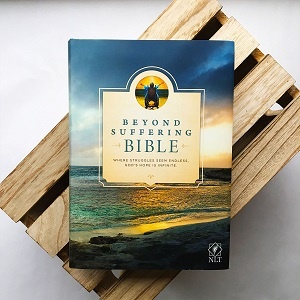
Throughout the Beyond Suffering Bible Joni Eareckson Tada shares personal insights on how God can use anything, even suffering, to bring us closer to him and display his glory. When our lives don’t go the way we want, when the suffering and pain seem too much to bear we have a choice, we can either rely on God or let bitterness consume us. Read what Joni has to say about a time when God brought her face-to-face with her own tendency to hold on to bitterness.

By Joni Eareckson Tada

Troubles. Hardships. Calamities. Ever heard that old adage, “Bad things come in threes”? It’s only folk wisdom, but somehow it seems true.

Bitterness was a temptation for me in the early days of my paralysis. Deep inside I knew it was wrong, but I justified myself by saying, “Surely God won’t mind if I let off a little steam now and then. After all, I am paralyzed!” But as many of us have learned, indulging in bitterness leads us down a path to even more despair and bitterness.

As if that trouble wasn’t enough, God added a second hardship. Several months into my hospital stay, I had an operation on my lower spine. After the surgery, I was forced to life face down for fifteen days while the stiches healed. “I am sick and tired of this,” I complained out loud.

Then, the third distress came: I caught the flu. Suddenly, not being able to move was peanuts compared to not being able to breathe. I was miserable! But as I thought about it, I understood what God was doing. No longer was my bitterness a tiny trickle; it was a raging torrent that could not be ignored. It was as if God was holding my anger up before my face and saying lovingly but firmly, “Stop turning your head and looking the other way. This bitterness has got to go. What are you going to do about it?”

The pressure had gotten so strong that I was either going to give the situation over to him completely or allow myself to wallow in bitterness. Faced with that ultimatum, I was able to clearly see what a wicked course bitterness would be. Sometimes troubles, hardships, and distresses—in groups of three (or more!)—back us into a corner and force us to seriously consider the lordship of Christ.

Lord, when troubles pile on, may I look to you for help and hope.


Find out more about Joni and her team at Joni and Friends .

Looks Inside the Beyond Suffering Bible

Making Sense of Faith in Suffering

WAY-FM’s World’s Biggest Small Group recently did a study on where God is in suffering. They used the Beyond Suffering Bible to explore how to connect the goodness of God with the pain and suffering we see in this world.

Having been a quadriplegic for fifty years after a tragic diving accident, suffering from chronic pain, and battling breast cancer, Joni understands the why question. But it wasn’t until she stopped asking why with a clenched fist and started asking why with a searching heart that she found hope.

In this study she shares the 10 words that changed her life and motivated her to bring God’s infinite hope to a hurting world. Hear her share her heart.

Learn more about the Beyond Suffering Bible study on WAY Nation

Look inside the Beyond Suffering Bible

What is Prayer?

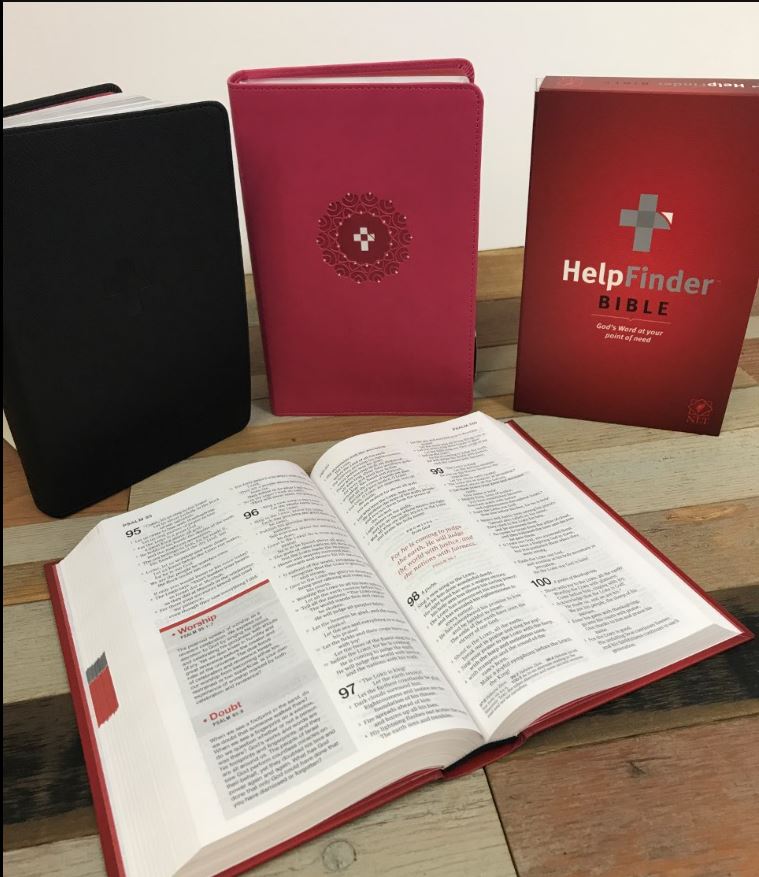
One of the themes that we focus on during the Lenten Season is prayer. Though most of us have prayed do we truly understand what prayer is? Let’s explore by seeing what the HelpFinder Bible has to say about prayer. The following is taken from the HelpFinder Bible index.

Prayer:
The most universally practiced yet least understood of human experiences, prayer is one of the great mysteries of the Christian faith. Its simplest definition is communication with God. Yet so often we approach prayer like a one-way telephone conversation, forgetting that God also wants to speak to us. And how do we pray—on our knees or standing; silently or out loud; alone or with others; by rote or spontaneously? And does prayer really induce God to change events or otherwise act on our behalf? Prayer appears on almost countless pages of the Bible as the very essence of a faith relationship with the living God. Simple enough for a child to understand and yet so profound we spend a lifetime plumbing its depths, prayer assumes that it is possible for us to have an intimate relationship with a God who hears, cares, and is able to act.


What is prayer?
2 CHRONICLES 7:14 | “Then if my people who are called by my name will humble themselves and pray and seek my face and turn from their wicked ways, I will hear from heaven.”
Prayer is a conversation with God. It is simply talking with God and listening to him, honestly telling him your thoughts and feelings, praising him, thanking him, confessing sin, and asking for his help and advice. The essence of prayer is humbly entering the very presence of almighty God.

PSALM 38:18 | But I confess my sins; I am deeply sorry for what I have done.
1 JOHN 1:9 | But if we confess our sins to him, he is faithful and just to forgive us our sins and to cleanse us from all wickedness.
Prayer often begins with a confession of sin. It is through confession that you demonstrate the humility necessary for open lines of communication with the almighty, holy God.

1 SAMUEL 14:36 | But the priest said, “Let’s ask God first.”
2 SAMUEL 5:19 | So David asked the Lord, “Should I go out to fight the Philistines?”
Prayer is asking God for guidance and waiting for his direction and leading.

MARK 1:35 | Before daybreak the next morning, Jesus got up and went out to an isolated place to pray.
Prayer is an expression of an intimate relationship with your heavenly Father, who makes his own love and resources available to you. Just as you enjoy being with people you love, you enjoy spending time with God as you get to know him better and understand just how much he loves you.

PSALM 9:1-2 | I will praise you, Lord, with all my heart. . . . I will sing praises to your name, O Most High.
Through prayer we praise our mighty God.

1 CHRONICLES 17:16-18 | “Who am I, O Lord God . . . that you have brought me this far? . . . You know what your servant is really like.”
Prayer is humbly acknowledging our humanness in relation to God’s greatness and perfection.

1 SAMUEL 3:10 | And the Lord came and called as before, “Samuel! Samuel!” And Samuel replied, “Speak, your servant is listening.”
Good conversation also includes listening, so make time for God to speak to you. When you listen to God, he will make his wisdom and plan known to you.

Take a Look Inside the HelpFinder Bible

David’s Repentance

“You will not reject a broken and repentant heart, O God.”
Psalm 51:17b, NLT

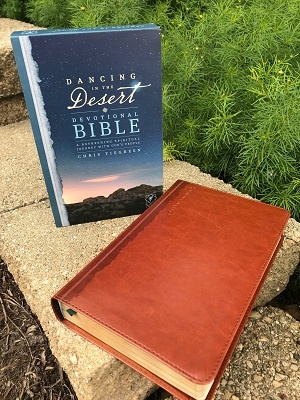
Devotional from the Dancing in the Desert Devotional Bible

David had sinned against Bathsheba and her husband, Uriah, and then
seemed to live in denial about the gravity of the situation. Only when Nathan the prophet confronted David with a piercing parable did the king see his sin. And unlike many kings who would have put the pesky prophet to death or banished him from the royal courts, David broke down in confession and repentance. He grieved. And he saw his offense against Bathsheba and Uriah as a sin against God himself (51:4).

Few things in life seem as hopeless as our own guilt. The sense of futility
and alienation is crushing. While many run from a painfully honest admission of guilt, we know that’s the only place to find restoration. And God is a restorer by nature. He doesn’t reject a broken spirit. He absorbs the penalty of sin himself. When we overcome pride and admit our brokenness, he repairs it and renews our joy.

Chris Tiegreen is an award-winning author of more than 50 books and discussion guides that have been translated into more than 30 languages and read by more than 5 million people worldwide. He is also a collaborative/supporting writer for other communicators (i.e., ghostwriter) on more about 20 book projects, and writer of hundreds of magazine and newspaper articles on a wide variety of topics. His experiences in media, ministry, and higher education bring a unique perspective to his writing, which often focuses on cultural commentary and devotional themes. He and his family currently live in Atlanta.

Reading Together

by Glenn Paauw, Institute for Bible Reading

Reading the Bible well doesn’t happen automatically. There are steps we must take to ensure we’re receiving the Bible on its own terms.

We read a well-translated Bible, and we read it holistically. We read complete literary units. If at all possible, we read in a nice, clean, elegant Reader’s Bible. They’re built to make reading easier and better, so no surprise there. But wait. Who is reading? We are. We are reading.

Really? We? Yes.

Why?

Because, first, research shows that most of us are not really reading the Bible very much. And second, when we do read it, it’s not really we who are reading. It’s more like me or you. In other words, those who are doing something with the Bible are overwhelmingly doing it alone.

The fact is, we’ve largely privatized our experiences with the Bible. We hold up the “daily quiet time” as the center of what we’re supposed to do with the Bible. We’ve created a culture in which an individual Bible experience is at the heart of what a serious Bible reader does.

Alone with a Bible, I have my private time with God.

Which is fine.

Of course, none of this is a problem as far as it goes. It’s great to read your Bible alone. Lots of very good things can and do happen.

But not all the good things that God intended. Two historical points are really important here. First, when the Scriptures were first experienced by God’s people, they were always experienced in community. There were very few copies, so a village in ancient Israel or one of the earliest Christian gatherings would at most have a copy of some of the books that now make up the Bible. As such, these Bible portions would be read aloud for the community, and people would simply listen.

Now, they could listen well and remember what they heard because they lived in an oral culture, a far cry from our context, in which written materials are so readily available. The historical evidence also shows that these listening experiences were interactive, not merely one-way communication. Everyone (including the leaders) was processing the sacred words together.

Secondly, and just as importantly, the original audience knew that the Bible itself was a community-formation book, not a private me-and-God book. The word you in the Bible is most often a plural word, not singular. God’s Word is addressed to the gathered people of God and is intended to speak to them in their corporate beliefs and actions. As a group, they were being invited to get caught up in God’s great restoration movement.

We’ve moved away from this ancient, oral, community-based culture in lots of ways. In fact, it is worth noting that the Bible first became widely available to individuals in their own language right at the same time that modern individualism was growing as a cultural force. We live and move and have our being in this individualism. It is the air we breathe. Without even thinking about it, we think and act in independent, self-oriented ways.

So for us, recovering a deep, transformative engagement with the Scriptures has to include rediscovering ways of experiencing the Bible together. And this means more than doing a Bible study together. We must back up a step and find new ways of simply reading the Bible together, listening to it being read and letting the words wash over us.

Then we must craft new ways of interacting openly and honestly with what we’ve read or heard. We must learn the humility to speak our own views respectfully and well, and then listen closely and seriously to what others have to say.

This communal engagement will look more like a book club than a traditional Bible study.

Finally, we need to think about the communal implications of a passage, not just the personal impact for ourselves as isolated individuals. Our Bible reading must explicitly raise community-based questions. What kind of community will embody this teaching or instruction? How can we become that kind of community?

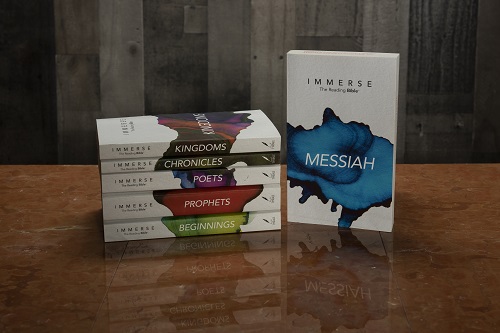
Bringing community-based engagement back to our Bible reading won’t happen unless we are intentional about making it happen. The Institute for Bible Reading has created a whole-church-based Bible reading program called Immerse precisely for this reason.

We don’t see, hear, experience, or know enough to experience the Bible sola me. We are too small to try to read this grand story only by ourselves. Together, we are the people of God’s new creation, and we need each other—even in our Bible reading, understanding, and, yes, living.

Read more from Glenn on how to receive the Bible on its own terms.

Fulfilling Our Unmet Needs and Desires

Devotional from the Life Recovery Bible

Read Proverbs 3:13-26

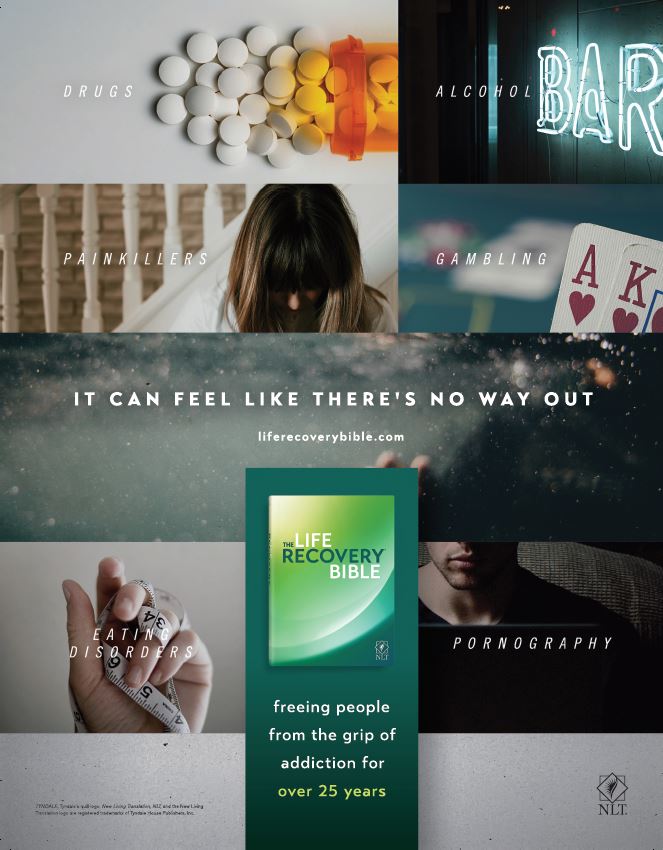
None of us set out to become addicted to something. We were seeking something else—escape from pain, perhaps, or something to make up for our losses and brokenness—or maybe we had a subconscious desire for self-destruction.

Unfortunately, the things we turned to could not satisfy our deepest
needs or desires. Our needs are legitimate. What must be changed is the tendency to go the wrong way to try to meet those needs. The Bible says, “My child, don’t lose sight of common sense and discernment. Hang on to them, for they will refresh your soul. They are like jewels on a necklace. They keep you safe on your way, and your feet will not stumble” (Proverbs 3:21-23).

Godly wisdom leads to great benefits in life. As we seek wisdom, we will find the other things we desire. “Joyful is the person who finds wisdom, the one who gains understanding. For wisdom is more profitable than silver, and her wages are better than gold. Wisdom is more precious than rubies; nothing you desire can compare with her. She offers you long life in her right hand, and riches and honor in her left. She will guide you down delightful paths; all her ways are satisfying” (Proverbs 3:13-17).

As we change our focus and begin to seek after wisdom, we will find our lives more fulfilled and secure. Godly wisdom will also help us avoid the destructive paths we have previously taken as we tried to fulfill our unmet needs and desires.

Zephaniah

Zephaniah might be a book that is often overlooked but the prophet brings an important message about pure worship. Read more from the Dancing in the Desert Devotional Bible 

Only decades before Jerusalem’s fall and one generation before
Jeremiah, Zephaniah warned of judgment. On the surface, he was an
unlikely source for such severe words. He was a descendant of one good
king (Hezekiah) prophesying during the reign of another (Josiah). Josiah
was early in the process of tearing down unholy altars and revitalizing the
nation’s worship. Things seemed to be moving in the right direction. What could be so bad that God would overthrow his people?

But Judah’s idolatry was too deeply entrenched to be reversed by Josiah’s reforms, though God would promise to withhold judgment until after the
good king’s death (2 Chronicles 34:28). So Zephaniah predicts the worst: “a day of terrible distress and anguish, a day of ruin and desolation, a day of darkness and gloom, a day of clouds and blackness” (Zephaniah 1:15). At times, his words seem broader than for just Judah and point to a greater, later judgment. But they are painfully urgent for his hearers. These spiritually complacent people are sabotaging their own destiny and are apparently desensitized to God’s voice. Zephaniah’s words are meant to jolt them out of their apathy. They need to know they will begin to experience God’s painful discipline in less than a generation.

Zephaniah’s prophecy doesn’t end in despair, of course. A restoration is coming, and God will delight in his people and rejoice over them with songs
(3:17). Again, Zephaniah’s words seem broader than for his nation alone. God’s restoration will have global consequences—the purification of all people for unified worship. Entire nations will come to worship him (3:9). Israel will be the centerpiece of a much bigger salvation than its people have expected.

That’s the goal of God’s plan. This ongoing battle throughout Scripture
and history is about one primary issue: worship. Idolatry, along with all its
symptoms, derails our ultimate purpose. Pure worship fulfills it. And God
will do everything necessary to bring the hearts of multitudes into alignment with his own.

Building a Firm Foundation

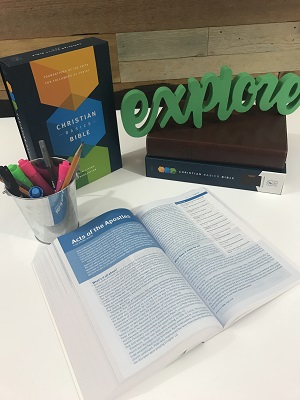
Matt Sherro is the pastor of Abounding Grace Baptist Church, a church plant in Phoenix, AZ.  Abounding Grace is intentional about reaching people for Christ. Instead of meeting in a building, they gather in a local park on Sunday mornings, inviting everyone to come worship and learn more about God’s plan of salvation. Read how Matt is using the Christian Basics Bible to disciple new believers.

I chose to use the Christian Basics Bible as my guide for one-on-one discipleship for many reasons. The primary reason was that it uses the NLT text. Over the last year, the NLT has become my favorite teaching translation. It is very easy to understand and is thus incredibly useful for discipleship. I cannot begin to explain the feeling when the person you are teaching finally connects with the Bible.

Many disciples, my own wife included, have commented that when they began reading the NLT, it was the first time they really felt like God was communicating with them. I would argue that when you begin using the NLT in your church, you will see similar results in the people you are discipling.

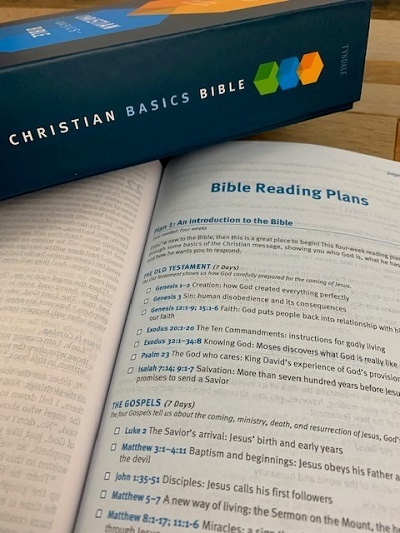
For us, the 28-day reading plan gets the most usage of any feature in the Christian Basics Bible, since most of the people I minister to have never seen the inside of a Bible. It is really helpful to begin here because it is a non-intimidating way to enter the journey of understanding Scripture. I am really glad to have this plan because, as a pastor, I sometimes have trouble with the fact that not every Christian is as familiar with or engaged in the Bible as pastors are.

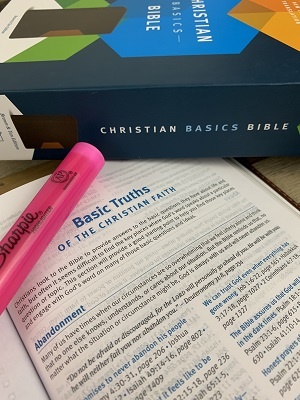
I also get plenty of use out of the topical articles and the “Basic Truths of the Christian Faith” guide, but not in the way you might expect. For many pastors, these articles would be useful as a sermon-preparation tool, to create topical series, for instance. But I like to pair the topical articles with Q&A sessions. I have new learners write down their questions on a particular topic, and then we turn to the “Basic Truths of the Christian Faith” guide to find out what the Bible teaches us on a particular topic. This allows me to connect in a unique way with individuals, as each new learner may have different areas of life in which they need to hear from God.

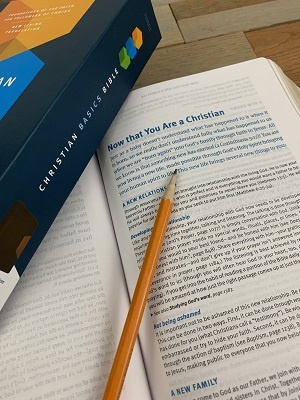
I’d like to round out my discussion by mentioning the “Now that You Are a Christian” article. This Bible was created to help new Christians develop into faithful disciples, and along those lines I get tremendous use out of this brief article. Here, we can take a new learner through the process of developing an understanding of God, Christ, sin, salvation, and the church. My goal is to help new disciples develop in their theology in such a way that their theology is strong enough to sustain them through the trials that will no doubt come as they mature in Christ.

There are a number of different ways to use the Christian Basics Bible in your ministry. I hope that it is as helpful to you as it has been to me.

If you are interested in learning more about Matt check out his blog.

Back to Basics

By Kevin O’Brien, Brand Manager

The world goes by at a million miles per hour, and it seems to get faster and become more complicated at every turn. It’s quite easy to get distracted, disgruntled, and even disillusioned. We chase so hard after the things we think we are supposed to pursue—success, respect, love, money, etc. We adopt the causes we are supposed to adopt, get outraged over the latest injustice that we are supposed to be outraged about. And next week it all changes.

Somewhere along the way, as the routines and cares of the world have distracted us, we have forgotten the reality of our faith. In all the busyness of life, our faith threatens to float away like dandelion seeds in the wind. We need a firm foundation.

We need to get back to basics.

The Christian Basics Bible reminds us what our faith is all about in the first place.

Becoming a Christian is not about deciding to live better, trying to be more holy, going to church, or following certain religious practices or behaviors. It is about beginning a personal relationship with God. Religious rules and duties will always end up tying us up, as Jesus often reminded the highly religious Pharisees of his day. Jesus came not to tie us up but to set us free (see, e.g., John 8:31-32; Galatians 5:1). He came with good news (the meaning of the word “gospel”); and this good news is that ordinary people—even people who feel unworthy or have failed or have done bad things—can know God personally and live in harmony with him. (p. A11)

That’s a pretty “back to basics” truth right there. It’s also unbelievably freeing if we take the time to actually read it, digest it, and be changed by it. But the busyness of life, even the trappings of our faith, can rob us of this truth.

So how can we make a practice of getting back to basics, of being a “basic believer”? There are a lot of good answers to that question, but here’s a starting point, a first step if you will. In the book of 2 Timothy, the apostle Paul wrote to his young apprentice Timothy. Timothy was leading a church in the city of Ephesus. Ephesus was rich, influential, and cosmopolitan. It was a center of religion and commerce and the most important city in the Roman province of Asia. It was the place to be. In fact, minus the technology, it probably had a lot of similarities to the type of crazy environment we find ourselves in today. Unfortunately, the church in Ephesus had all kinds of problems. Here’s what Paul tells Timothy:

“Preach the word of God. Be prepared, whether the time is favorable or not. Patiently correct, rebuke, and encourage your people with good teaching. For a time is coming when people will no longer listen to sound and wholesome teaching. They will follow their own desires and will look for teachers who will tell them whatever their itching ears want to hear. They will reject the truth and chase after myths. But you should keep a clear mind in every situation. Don’t be afraid of suffering for the Lord. Work at telling others the Good News, and fully carry out the ministry God has given you.” (2 Timothy 4:2-5, NLT)

Here’s what the Christian Basics Bible says about this passage:

A lack of studying Scripture had led the Ephesian church to be led astray by every new idea that came along. So Paul urges Timothy to keep studying Scripture so he can use it to correct error and explain the truth (4:2-5). We need this book because it is not like any other book, secular or sacred. It is “inspired by God” (3:16). That is, God’s Spirit directed the thoughts of its writers so that what they wrote was exactly what God wanted written. The Bible is therefore God’s revelation to us—revealing his nature, heart, and purposes—and his invitation to join in his story. (p. 1387)

Maybe you’re not in a pastoral role like Timothy—and maybe you never will be—but the advice still stands. The only way Timothy could teach others was to be captured by the truth himself, to really know it. Getting back to the basics of our faith and of our relationship with God starts with getting back into his Word.

I want to be a basic believer. How about you?

Take a Look

Inside the Christian Basics Bible