“In the beginning the Word already existed. The Word was with God, and the Word was God. He existed in the beginning with God. God created everything through him, and nothing was created except through him. The Word gave life to everything that was created, and his life brought light to everyone. The light shines in the darkness, and the darkness can never extinguish it. John 1:1-5, NLT
Eventually every child gets around to asking the question, “Where did God come from?” And there is no easy answer for that, except to say, God has always existed. He is self-existent. He already existed in the beginning. God has no beginning, nor does he have an end.
It is worth noting that the Bible never tries to prove the existence of God. It just says, “In the beginning God created the heavens and the earth” (Genesis 1:1). You can’t go back any further than that! Now, certain people would like to eliminate the major player here. They’d rather the verse read, “In the beginning, the heavens and the earth . . .” But if we eliminate God, then we have a big problem. In the beginning . . . what?
Some would say, “In the beginning, a mass of gases was floating in space.” But that’s not the beginning. Where did the mass of gases come from? Where did space come from? The Bible simply says, “In the beginning God.”
The Bible doesn’t tell us when the beginning was; it just says God was already there. And here, John tells us that the Word, Jesus Christ, already existed in the beginning with God ( John 1:2). He was with God, he was God, and God created everything through him ( John 1:1, 3).
Sometimes we speak of God by describing his attributes: omniscience, omnipotence, omnipresence, sovereignty, truth, righteousness, holiness, and love. While these descriptions can help, if you really want to know what God is like, then look at Jesus—God in human form. Jesus did not represent God as a glorified man; he was God himself among us, the Messiah in human flesh, God with skin on. God has a face. Jesus, who embodied all of God’s attributes, walked our planet as a man and breathed our air and felt our pain. He was so knowledgeable he could predict future events, so humble he could get on his knees and wash a friend’s dirty feet, so powerful he could calm the wind and waves with just a word, so approachable that children laughingly climbed into his arms. In Jesus, God spelled himself out in language that every one of us can understand.
“Dear friends, don’t be surprised at the fiery trials you are going through, as if something strange were happening to you. Instead, be very glad—for these trials make you partners with Christ in his suffering, so that you will have the wonderful joy of seeing his glory when it is revealed to all the world.If you are insulted because you bear the name of Christ, you will be blessed, for the glorious Spirit of God rests upon you. If you suffer, however, it must not be for murder, stealing, making trouble, or prying into other people’s affairs. But it is no shame to suffer for being a Christian. Praise God for the privilege of being called by his name! For the time has come for judgment, and it must begin with God’s household. And if judgment begins with us, what terrible fate awaits those who have never obeyed God’s Good News? And also, ‘If the righteous are barely saved, what will happen to godless sinners?’ So if you are suffering in a manner that pleases God, keep on doing what is right, and trust your lives to the God who created you, for he will never fail you.” 1 Peter 4:12-19, NLT
First Peter is focused almost exclusively on Christian suffering, especially unjust persecution at the hands of people hostile to the faith. The several themes about suffering that are woven throughout the letter find their climactic expression in 1 Peter 4:12-19. Peter makes the following points about suffering:
1.We should not be surprised when suffering comes (4:12). Christians who live a countercultural lifestyle in obedience to God should expect the culture to respond with hostility. We should expect mockery, discrimination, trumped-up charges, and even violence.
2. God has a purpose for us in suffering: It brings us into fellowship with Christ, who suffered before he was glorified (4:13; see also Rom 8:17).
3. By suffering in fellowship with Christ, we can be confident of enjoying the glory that he has already won (4:13; see Rom 8:17).
4. We need to commit ourselves to doing what is right when we face suffering (4:19). Our difficulties can always provide an excuse for sinning, but when difficulties come our way, we must live exemplary Christian lives, characterized by love for others.
5. Our loving response to enemies in the midst of trials can be a powerful opportunity to share our faith. By treating our persecutors with love and kindness, we can make our faith respectable and even attractive to them.
6. We need to remember in our trials that God is both sovereign and faithful (4:19). He controls all the circumstances of life, and we don’t need to fear that a trial will come our way apart from God’s oversight or will.
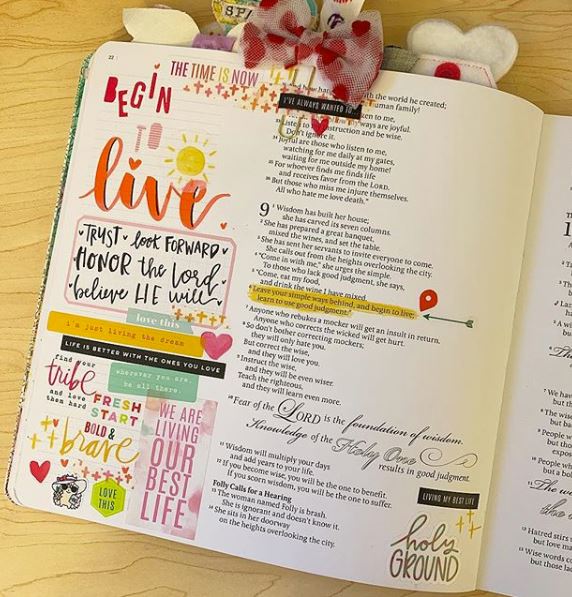
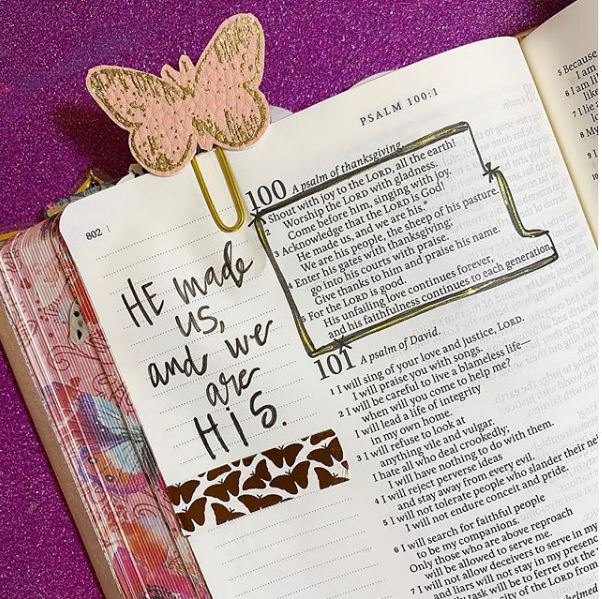
I love to Bible journal. I find myself these days spending any spare time I have, sitting at my table thirsting for time in his word. Ever since I discovered Bible journaling, I have a hunger for God’s word like I have never had before. I am so thankful for this community and for what it has taught me. I have many journaling Bibles but the one I always reach for these days is my NLT Reflections Bible. I have the hardcover cloth, teal version. This is actually my second one that I’ve had. The first one, I sent off as a Traveling Bible to be journaled in by ladies all over the United States and eventually gifted to a family who lost their daughter to cancer. It was such a special gift!
Bible journaling is a way for me to connect with my Savior. It’s a form of worship for me. It allows me to meditate on his word and grow creatively while I study it. When I begin my journaling process, I pray over the verse I’m journaling and ask the Lord to speak to me. I always have my worship music keyed up as well. This is another way for me to connect with him. With the music going, prayers being said, meditating on the verses, it’s an amazing time to spend being creative!! Whether it’s using stamps, watercolors, printables, acrylic paints, or distress oxides (my absolute favorites), it’s time spent in his word.
I love how the Reflections Bible has white pages because all the colors and designs just seem to pop off the pages and when you highlight the verses, it seems to show up even more. After I am finished with creating, I will usually write a small prayer, date my entry (I hope to pass my Bibles on to my family someday for them to enjoy, that’s why I date them, plus I like to look back on the entries and see where the Lord has brought me from on those days), and close with prayer. If I decide to share that particular page with social media, I’ll snap a picture sometime after. It’s time well spent, I’ve learned a new verse or revisited an old one. I’ve been able to use my creative skills and I’ve had alone time with my Savior all rolled up into one. My heart couldn’t be fuller!
The
Reflections Bible has another favorite of mine, it’s in the NLT translation.
When I’m reading or listening on audio to the Bible, it’s one of my favorite
translations to use. It’s so easy to understand and still holds true to the
original text. If you look on Tyndale.com, you can read in detail how they have
translated the Bible, what process what used, ancient texts, and much more
information is given. I love to read the history and know in detail about the
translations I read. This is why NLT is one of my favorites.
We could go on forever about how much we love creative Bible journaling. It’s so much more than coloring or drawing or expressing our faith—it’s worship! It’s our personal response on the page to what God is doing in our hearts. As you may know, Bible journaling has become a deeply treasured devotional practice for many. It is drawing people into Scripture like never before. Journaling Bibles are not sitting on shelves collecting dust. Scripture is being read, meditated on, studied, prayed over, colored, embellished, and responded to!
God speaks to us through the Bible, and faith is strengthened, wisdom is gained, truth is proclaimed, wounds are healed, minds are transformed, relationships are mended, hurts are forgiven, hearts are surrendered, courage and strength grow, and so much more! God’s Love is flooding into hearts as people meditate on his Word, and God’s Truth is spilling off the page and out into the world!
We invite you to indulge in the 14 reasons why we LOVE Bible
journaling! We also invite you to try it for yourself. You might discover
you’re a lot more creative than you think, or it might open up a whole new way for
you to read and engage with Scripture that radically transforms your time with
God! One thing is for sure: God’s Word never returns void.
1. The Bible was written for you and me to read and study
and learn from. Bible journaling is a fun way to respond to what we’ve read.
God’s Word is alive and powerful!
2. God speaks to us through the Bible, and no matter how
many times we’ve read our Bibles, there is always a fresh word or perspective
or learning. No two journaling Bibles are ever alike.
3. Bible journaling is an act of worship and can even be
done in community!
4. Being creative in our Bibles draws us deeper into God’s
Word and helps us remember the truths that we learn so we can apply them to our
lives.
5. It’s 100% meaningful; time spent in God’s Word never
returns void.
6. It’s a creative process that calls out the creativity God
gave you. You were made in his image. He is creative, and so are you!
7. It’s a unique way to study God’s Word. We can express
ourselves to God and discover God’s truth in a new and exciting way.
8. It’s a great way to share your legacy of faith with your
children or grandchildren and can even become a family tradition.
9. It encourages time in God’s Word.
10. It doesn’t have to be beautiful to be meaningful.
11. It’s a way to reflect our hearts to our Creator and to
respond to what God is doing in our hearts through his Word.
12. Bible journaling is colorful! Our colorful Bibles are
beautiful reflections of our time spent in God’s Word! We can go back to them
time and again and revisit the pages we’ve journaled for encouragement and as a
reminder of God’s faithfulness.
13. We are inspired by God’s Word!
14. It’s fun!
Click on the images below to download some pages from our journaling Bibles and try creating Bible journaling for yourself.
Penicillin, saccharine, Coca-Cola, the microwave oven and the pacemaker…all have one thing in common: they all came about by accident, discovered when someone found something that they weren’t originally looking for. And that’s how the Christian Basics Bible came about.
It all started
with my being deported from India….
After more than 25 years of working with churches, leaders and seminaries in India, I landed at Chennai to find that I had been ‘red flagged’ and was promptly put back on the very plane from which I had just disembarked. Over those 25 years, I had made hundreds of friends – one of them, a seminary student from Myanmar (formerly known as Burma) with whom I had become particularly close when his father suddenly died and, as acting principal of his seminary at that time, was able to help him get back home to his family in that time of need. That moment forged a link between us that lasts to this day. When he graduated, he returned to Myanmar where he became a lecturer at a seminary in Yangon. After much pestering, he persuaded me to go there as a visiting professor – and so began my love for Myanmar and its many different peoples.
As it happens, my long-standing friend and co-author of Christian Basics Bible (CBB), Martin Manser, also has a link with Myanmar since he married a Burmese woman. And it was this love of Myanmar on both our parts that would lead to the production of CBB.
It was while
Martin was in Yangon visiting his wife’s family on one occasion that he met the
Director of Christian Literature Crusade Myanmar. Knowing Martin was an author and editor of many
years’ experience, he shared with him his longing for some kind of Study Bible
in the Burmese language, since there wasn’t a single one at that time, and
wondered whether Martin might be able to help. Martin promised to give it some
thought. And as he did, two things came to mind. First, he remembered that he had
written some short introductions to the books of the Bible some years earlier,
but nothing had come of the material. Second, he reflected on how he and I had
collaborated on writing projects for over 20 years. Suddenly, the light went
on. What if he put those two things together?
When he got back home,
he contacted me, asking whether I would be interested in partnering with him in
producing the first ever Study Bible in the Burmese language. As we prayed
about it and discussed the idea further, we began to get really excited and
felt this was something that God wanted us to do. For us in the West, where
there is a plethora of Bible translations and editions, it’s hard to grasp what
it is like for many Christians in the world where they often only have one
basic translation, often without any notes or helps of any kind in it. This was
certainly the case in Myanmar, where there was only one Bible text – the Judson Bible, produced in 1834 and without
a single footnote or comment in it. Even worse, there had been no revisions of
that 1834 text; so many of the words in it were now simply quite meaningless in
modern Burmese. So CLC got to work slightly updating the Bible text, while Martin
and I got to work at our end – Martin using his skills as an editor to plan and
shape the material, me using my skills as a writer to start producing the
content – introductions to each Bible book and notes on key themes every 6 or 7
chapters or so. The publisher had requested we keep the material simple and
compact, yet comprehensive – quite a challenge! And, of course, it had to be
culturally relevant for Myanmar where some issues arise that just aren’t
tissues in the West. After lots of hard work, we are glad to say that the
Myanmar Study Bible was finally in the hands of Christians there – the first Study
Bible in the Burmese language.
Because this is where the penicillin and saccharin and Coca-Cola come in. For it was while we were working on this project for Myanmar that the idea of CBB was born. One day, during a phone conversation about the project, Martin suddenly said to me, “You know, this material is really good. I’m sure there is potential for it being used much more widely.” And immediately, I knew that he was right. For there we were, trying to express what are often complex and profound spiritual truths in simple ways for Myanmar Christians, when many in the West were in need of exactly the same thing. In fact, I had been greatly exercised for a number of years as a pastor by the fact that more and more people in the West were becoming more and more ignorant of even the most basic Bible stories (let alone doctrines). And so when they became Christians, they brought very little, if any, of the Bible background that people of a generation ago would have brought, making the Bible so much harder to understand.
And so we began to
dream. What if we were to produce an edition of the Bible that was especially
written for people who came to faith with little or no Bible background? What
if we were to write things in really simple way, avoiding ‘Christianese’ and
technical language that those of us who have been Christians for many years so
often take for granted and use without thinking? …
And so we began to draft an outline of what would become known as Christian Basics Bible. It would have some introductory essays on things like how to become a Christian and how to read the Bible; each Bible book would begin with a simple summary of what it was all about and what the reader should look for as they read it; there would be notes, but not too many so we didn’t overwhelm the reader, focusing on key ideas, people and events; it would have sections at the back, with a glossary to explain words whose meaning we often take for granted, and a section outlining some of the basic truths of the Bible, to help people know where to look when they were thinking about various issues. We then produced some sample material to show the kind of thing we were thinking of, and sent it off to Tyndale.
We can’t tell you how happy we were when we got an immediate positive response from them! (Any author will tell you they often expect at least ten rejections before any publisher even starts to show an interest.) Tyndale was excited by our concept and asked if we could meet senior staff members who were due to pass through London England soon. And so, over lunch in a London hotel, CBB was born. Like Coca-Cola, by accident.
Over the next
couple of years, Martin and I devoted much of our time to the project, writing
and re-writing until we got the tone that we wanted – pastorally warm; simple
yet Biblically accurate; written in language for people who hadn’t been exposed
to the Bible before; seeking to be as neutral as possible over issues over
which equally-lovely Bible-believing Christians have genuine disagreements so
that it could be used by the widest possible base; and, of course, based on the
easy-to-read New Living Translation. Yes, I know some Christians don’t like
this edition because they think it isn’t close enough to the original text.
Well, it is close – it just uses a different translation principle: what is
known as ‘dynamic equivalence’ rather than ‘word for word’. And since it is
designed for people who have little or no Bible background, it is so much
easier for them to read and understand in comparison to versions like KJV or
NASB or even NIV.
As the final edited text started drawing to a conclusion, Tyndale’s design department got busy, producing some amazing info-graphics for the back of the Bible. Then they asked for our input on its cover. I said I didn’t really mind how it looked – providing it didn’t say ‘Holy Bible’ and have a cross on the front! If that shocks you, then please remember the purpose of CBB: to be an edition for new believers from little or no Christian background, not primarily for those who had been Christians for a long time for whom such things have become the norm. (And anyway, the original Bible texts didn’t say ‘Holy Bible’ and have a cross on them!). And so we came up with the idea of a cover with three building blocks, reflecting what had become something of a sub-title for CBB: Foundations of the faith for followers of Christ.
What a joy it was
to hold my very first copy in my hands, some three years after that Coca-Cola
moment!
Since its launch Christian Basics Bible has been well-received. Those who have recently become Christians and who come from little or no Christian background, have found it easy to read and understand. But also those who have been Christians for many years have find its approach and simplicity refreshing, commenting on how they have now understood things in the Bible that have passed them by for years.
So there it is: the Bible that came about ‘by accident’. But many of the things that come about ‘by accident’ prove to have enduring popularity. Our prayer is that this might be true of Christian Basics Bible.
The book of 1 Samuel begins with the birth of the prophet Samuel
and ends with the death of King Saul. It contains a catalog of lives for us to
learn from—some exemplary, others not. Samuel was born in the time of the
judges, when “people did whatever seemed right in their own eyes” (Judges
17:6). The people were far from God. Eli was high priest, but the flaws in his
leadership can be seen in the dysfunctions of his own family. Since Israel
lacked strong spiritual leadership, God chose Samuel and prepared him to lead
the Israelites back to God.
Near the end of Samuel’s ministry, the people demanded a king;
they wanted to be like the surrounding nations. God was not pleased with
Israel’s demand, but he chose Saul to lead them anyway. Saul, though a man of
great potential, was self-centered and disobedient; he never achieved what God
had intended for him.
While Saul was still king, Samuel anointed David to be the next king. David became a national hero by killing Goliath, and he won numerous other great battles with God’s help. But when Saul realized that David was in line for the throne, he was consumed by bitterness and tried to kill him.
Finally, faced with defeat in battle, Saul took his own life. This book portrays some who moved toward God and toward wholeness and others who moved away from God and toward disaster. Jealousy, bitterness, and disobedience destroyed the life of King Saul. But forgiveness, trust, and obedience brought David great success. This book clearly shows that the only way to wholeness is by trusting and obeying God and following his program.
THE BOTTOM LINE
PURPOSE: To track Israel’s transition from the period of the judges to the era of kingly rule. AUTHOR: Unknown, but probably most of it was written by Samuel. Nathan and Gad were also contributors. AUDIENCE: The people of Israel. DATE WRITTEN: The book was probably started during Samuel’s lifetime and finished around 930 b.c. SETTING: In Israel, between 1120 and 971 b.c. KEY VERSE: “What is more pleasing to the Lord: your burnt offerings and sacrifices or your obedience to his voice? Listen! Obedience is better than sacrifice” (15:22). KEY PLACES: Shiloh, Gilgal, Ramah, Bethlehem, Gath, Adullam, Hebron, the wilderness of Judah, Ziklag, Endor, Beth-shan. KEY PEOPLE AND RELATIONSHIPS: Samuel and Eli, Samuel and Saul, and Samuel and David.
The authors of the Life Recovery Biblehave recently released four workbooks that meet the needs of people dealing with compulsive behaviors that go beyond alcohol and substance abuse. These workbooks complement The Life Recovery Bible and focus on developing a biblical foundation for both understanding and successfully overcoming specific areas of struggle. Learn more
Nebuchadnezzar or Nebuchadrezzar (king of Babylon)
by Mark D. Taylor, Chairman / CEO, Tyndale House Ministries
Nebuchadnezzar II was king of Babylon for 43 years—from 605
to 562 b.c. He is mentioned in
many ancient Babylonian documents, and he played a pivotal role in the fall of
the Kingdom of Judah. As described in 2 Kings 24:1—25:26, Nebuchadnezzar
invaded Judah three times. The first invasion was in 605 b.c., the first year of his reign. The
second was in 597 b.c., in the
eighth year of his reign. Finally, he invaded again in 588-586 b.c., when he destroyed Jerusalem and
the Temple of the Lord.
The story of Nebuchadnezzar’s impact on the Kingdom of Judah
is told in five Old Testament books—2 Kings, 2 Chronicles, Jeremiah, Ezekiel,
and Daniel. His actual name is found 91 times in the Hebrew (or Aramaic) text,
but it is spelled two different ways—Nebuchadnezzar (with an “n”) and
Nebuchadrezzar (with an “r”). The translators of the King James Version (KJV),
Revised Standard Version (RSV), and New Revised Standard Version (NRSV) chose
to follow the different Hebrew spellings as they transliterated the name into
English. Most English translations, including the NLT, use the more common
spelling—Nebuchadnezzar—throughout the text to allay potential confusion on the
part of readers. The NLT also provides a textual note for each chapter in which
the Hebrew spelling Nebuchadrezzar (with an “r”) is transliterated as
Nebuchadnezzar (with an “n”).
This is just one example among many, many ways the NLT translators have worked to make the English text as clear as possible for our readers.
by Dr. Barry C. Black, Chaplain of the United States Senate
The One Year Pray for America Bible provides springboards for prayer that enable you to pray more effectively. It gives a different prayer prompt each day, encouraging us to pray for our government and make petitions on behalf of our leaders and fellow citizens for security, forgiveness, mercy, justice, humility, and wisdom. Prayer enables us to make our voices heard in heaven regarding America’s needs.
Prayer helped to make America a beacon of freedom. At the
birth of this nation, people sought God’s help in making the dream of Liberty a
reality. At the 1787 Constitutional Convention, when the participants had reached
an impasse, Benjamin Franklin suggested that they pray, and they eventually
did. Those prayers aided in our nation’s birth.
One of the first acts of the new American legislative branch
in 1789 was to establish a chaplaincy. A key responsibility of this chaplaincy
was to begin each legislative session with an invocation. Prayer has continued almost
uninterrupted since that time, because seeking God’s assistance for a person,
nation, or world is laudable. The Bible reminds us, “Godliness makes a nation
great, but sin is a disgrace to any people” (Proverbs 14:34). Humanity can
cooperate with Divinity in making a nation great.
If our nation started with prayer, perhaps we should also
sustain it with the same. We should get back to praying because, after all, God
is sovereign over all nations. Job 12:23-24 says this about God: “He builds up
nations, and he destroys them. He expands nations, and he abandons them. He strips
kings of understanding and leaves them wandering in a pathless wasteland.”
These verses make it clear that humanity will not have the ultimate word in
what happens to nations; God will.
Getting Back to
Praying for Our Nation
We should get back to praying for our government because God
has ordained government to establish order in society. The apostle Paul puts it
this way:
Everyone must submit to governing authorities. For all
authority comes from God, and those in positions of authority have been placed
there by God. So anyone who rebels against authority is rebelling against what God
has instituted, and they will be punished. For the authorities do not strike
fear in people who are doing right, but in those who are doing wrong. Would you
like to live without fear of the authorities? Do what is right, and they will
honor you. The authorities are God’s servants, sent for your good. But if you
are doing wrong, of course you should be afraid, for they have the power to
punish you. They are God’s servants, sent for the very purpose of punishing
those who do what is wrong. So you must submit to them, not only to avoid
punishment, but also to keep a clear conscience.
Pay your taxes, too, for these same reasons. For government
workers need to be paid. They are serving God in what they do. Give to everyone
what you owe them: Pay your taxes and government fees to those who collect
them, and give respect and honor to those who are in authority. (Romans 13:1-7)
God ordained government for our good. Paul instructs us that
government officials deserve our prayers, finances, honor, and respect.
We should get back to praying for our government because God
commands us to pray for it. We find these words in 1 Timothy 2:1-4, “I urge
you, first of all, to pray for all people. Ask God to help them; intercede on
their behalf, and give thanks for them. Pray this way for kings and all who are
in authority so that we can live peaceful and quiet lives marked by godliness and
dignity. This is good and pleases God our Savior, who wants everyone to be
saved and to understand the truth.”
We should get back to praying for our government because
life should not be divided into sacred and secular. God has sovereignty over
all our lives because in him we live, move, breathe, and function (Acts 17:28).
According to Proverbs 21:1, even the king’s heart is in God’s hands; the sovereign
God guides the king’s heart as he desires. Our lives are sustained by a
powerful divine providence, and the sacred permeates every part of our
existence, including government.
We should get back to praying for our government because
people of faith have a role in influencing public life and policy. We must give
to Caesar what belongs to him (Matthew 22:21), fostering morality in government
and holding authorities accountable. The Bible challenges us to be salt and
light to our world (Matthew 5:13-16). This means refusing to be missing in
action when it comes to governmental affairs. Esther, Nehemiah, and Daniel are
just three examples of how believers should relate to government constructively.
We should get back to praying for our government because the
ends sought by the government should be morally acceptable. In short, when Caesar’s
dictates collide with God’s commands, we must obey God instead of Caesar (Acts 5:29).
When the Babylonian king demanded that Daniel and his friends eat inappropriate
food, Daniel negotiated an acceptable alternative that satisfied this demand
(Daniel 1:5-16). When, however, the same king insisted these young men bow and
worship an idol or be executed in a fiery furnace, the young men chose to risk
death rather than compromise their faith (Daniel 3:1-18). Therefore, we must
cooperate with government whenever it does not violate our allegiance to God
and resist it when it does. Part of our cooperation entails praying.
We should get back to praying for our government because we
are urged to pray for others. In Jesus’ model prayer for his disciples (Matthew
6:9‑13),
the pronouns are plural. It does not say “My Father” but “Our Father.” We are
not told to pray “give me today the food I need,” but “give us today the food
we need.” Jesus does not admonish us to pray “don’t let me yield to temptation,
but rescue me from the evil one,” but “don’t let us yield to temptation, but
rescue us from the evil one.” Although some may find it difficult to believe
that the effectiveness of prayer goes beyond the private and interior life of
the intercessor, the Bible urges us to pray for others (James 5:16).
We should get back to praying for our government because
intercessory prayer is an affirmation of faith in the God who desires to serve
humanity. God says in Ezekiel 33:11: “As surely as I live, says the Sovereign
Lord, I take no pleasure in the death of wicked people. I only want them to
turn from their wicked ways so they can live. Turn! Turn from your wickedness, O
people of Israel! Why should you die?” In his book on prayer, Eric Hayman
observed, “The power of our intercession is not our isolated pressure on a God
remote from us. It is the action of His Spirit in and through our little souls,
self-offered to the purpose of His will. So our intercession depends on our
keeping open both to the perfect will of God and also the need and suffering of
the world.”* Perhaps this is why Elton Trueblood speaks of the church as a
“fellowship of the concerned.”†
We should get back to praying for our government because God
blesses nations that acknowledge him. Psalm 33:12 states: “What joy for the nation
whose God is the Lord, whose people he has chosen as his inheritance.” God
shows special favor to those who respect his sovereignty. He protects these
nations, surrounding them with the shield of his love (Psalm 5:12).
How We Should Pray
So, how should we pray for our government? First, we should pray for our government’s needs. One Greek word that can be translated as “supplication”in 1 Timothy 2:1 is deēsis, which is a word that suggests that God expects us to ask him to meet our government’s needs. God has promised to supply all our needs out of his celestial bounty (Philippians 4:19). He invites us to cry out to him when we are confronted with trouble (Psalm 50:15).When our government is overwhelmed by moral, financial, and even safety concerns, we should intercede for its needs. We have an example of praying for the needs of the government in James 5:16-18. These verses remind us that Elijah prayed and asked God to stop the rain from falling. Elijah was concerned because the government under King Ahab had endorsed the worship of Baal. The government seemed certain that it was Baal who sent the rain and produced a bountiful harvest, not the God of Israel. Elijah was concerned about governmental deviation from God’s law. He wanted the sovereign God of Israel to assert himself, and God answered his prayer,which was prompted by this need.
Second, we should pray with total dependence on God. Another Greek word in 1 Timothy 2:1 that can be translated as “prayer” is proseuchē. This word suggests that we should seek God as the sole provider of our government’s success. This dependence on God’s power is implied in Psalm 127:1: “Unless the Lord builds a house, the work of the builders is wasted. Unless the Lord protects a city, guarding it with sentries will do no good.” The notion of total dependence upon God is also captured in the Ten Commandments given to Moses by God on Mount Sinai: “You must not have any other god but me” (Exodus 20:3). God desires to be our sole provider.
Third, we should pray confidently, knowing that we have complete access to God. The Greek word enteuxis in 1 Timothy 2:1 can be translated as “petition.” In this word, we can see an admonition to come boldly before God’s throne of grace to receive help in the time of need (see also Hebrews 4:16). We hear this same sentiment in 1 Peter 2:9, which describes believers as royal priests. A priest is someone who has access to both God and the people and is a bridge between God and the people. When we pray for our government, we should intercede with an awareness of our complete access to God in heaven.
Finally, we should pray with thanksgiving. The final Greek word in 1 Timothy 2:1 that shows us how to pray is eucharistia, which can be translated“thanksgiving.” Thanksgiving adds perfume to our petitions ascending to God’s throne. Philippians 4:6 says: “Pray about everything. Tell God what you need, and thank him for all he has done.” Everything includes our prayers for our government. Believers are also encouraged to give thanks in every circumstance (1 Thessalonians 5:18). Continual thanksgiving is God’swill for our lives.
The Difference Prayer
Can Make
Imagine the difference our prayers would make if we asked
specifically for God to deal with the needs of our nation. What would happen if
we prayed for a stronger economy, or more harmonious race relations, or greater
civility among our political leaders, or better cooperation between our
branches of government? Specificity matters. God is waiting for us to be
specific about our needs.
Imagine what would happen if we sought God as our first
option—not the fourth or fifth. It would be wonderful to avoid the mistakes of
the disciples in a storm at sea. They first attempted to save themselves; they
waited before awakening Jesus (Mark 4:35-41). Our prayers for government can be
energized by understanding that God is the sole source of our strength and
help.
Imagine what would happen if we took frequent advantage of
the complete access God has given us to his throne because of our status as
royal priests. It can take months to meet with a government leader, but God has
provided us with continuous access to his presence, mercy, grace, and might.
Imagine what would happen if Thanksgiving came every day instead of once a year. How much more effective our prayers would be if we decided with the psalmist to praise the Lord at all times, with his praises constantly on our lips (Psalm 34:1). Perhaps then we would know experientially the truth of Psalm 22:22-31, which envisions a holy God who is continually praised by his people. The greatest days of our nation are linked to the holiness of its citizens. By God’s grace, let’s get back to prayer. The One Year Pray for America Bibleis a great starting point.
* Eric Hayman, Prayer and the Christian Life (London:
Student Christian MovementPress, 1948), 122-123.
† Elton Trueblood, Alternative to Futility (New York: Harper and Brothers, 1948), 58.
Look Inside the One Year Pray for America Bible
The Transformational Simplicity of the Whole Bible in One Year
What are some first impressions of the Bible? It’s a big
book. It seems overwhelming. It’s filled with people and places that seem
different than us and our surroundings. If we take a closer look and actually
get into its pages, we discover it’s extremely personal, and the people and
places actually look a lot more familiar to us than they did at first glance.
But what about the overwhelming part? It can be hard to know where to begin or
how everything is connected.
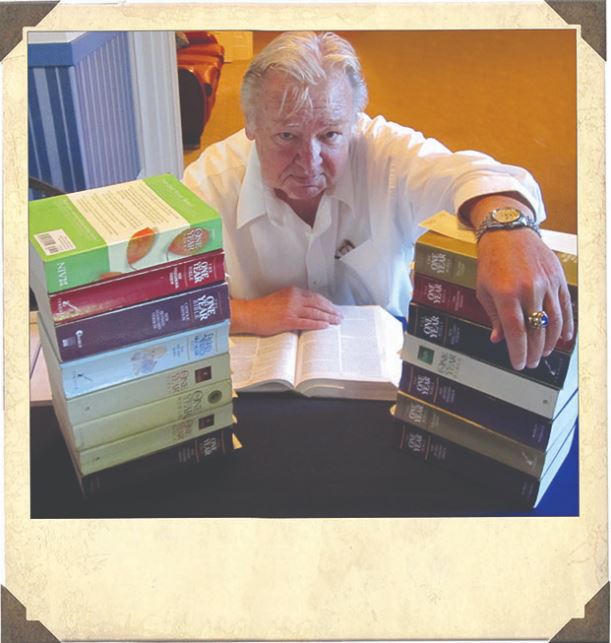
The One Year Bibleis a great resource to help us engage with the Bible in a manageable way. It takes the entire Bible and breaks it down into daily readings. It sounds so simple, and yet it’s transformational. From seekers to life-long believers, The One Year Biblehas helped people understand God’s story and what it means to each of us.
Dishy was not a Christian when he started reading the Bible.
He questioned its validity and wondered why people would believe it’s true.
“I have spent much of my life wondering whether any of
Christianity’s teachings were true or just wishful thinking, and perhaps also a
good sales job perpetuated by ancient people with an agenda. But it’s quite
easy to have an uneducated opinion about something you vaguely know about but haven’t
actually read! So, I decided to start putting forth an effort to read the
actual Bible, the whole thing, from beginning to end. I hoped that this
exercise would put the issue to rest in my life and I would be able to decide
once and for all what I thought about Christianity,” he said.
“I really like the read-it-in-one-year concept with
scheduled daily passages. It is helpful to refer to a study Bible to
occasionally get more background and explanation. This One Year Bible encourages me to keep up with it. Since the passages
aren’t very long each day, I think Surely
I can read this for 10 or 15 minutes. So, whoever thought of the concept
had a really great idea.”
Is this still a good Bible for people who have been reading
it most of their lives? Hank thinks so. He is a lifelong Christian and has read
the Bible every day for almost 30 years.
“I love the Bible. It’s such a joy to read it, and I just
want everyone to have that joy and understand what it can give you,” said Hank.
He started with his family.
“For 19 years I read a One Year Bible, and each year I dedicated it to a family member. The notes in the margin were personal, such as ‘This is my prayer for you.’ I’ve underlined, circled, and highlighted many passages, letting them know what inspires me. It is my legacy to them,” said Hank.
Through these Bibles Hank has inspired a love for God’s Word
in others. Sharing his struggles, joys, failures, and triumphs as he moves
closer to God has been a comfort and a catalyst for his family members to grow
deeper in their understanding of God through his Word.
“When I give it to them and they read it, they always come back saying, ‘I didn’t know you were going through that’ or ‘when you wrote this it helped me to better understand what I was facing.’ The Bible gives me joy whenever I read it, and I get joy by sharing it with others. The more you get into it, the more your joy will grow,” said Hank.
Take a Look Inside The One Year Bible
Was Mary, Jesus’ Mother, Ever Afraid?
We often think of Mary, Jesus’ mother, as the beautiful young woman who the angel visited to share of the coming of Christ. And that the Messiah would come into the world through her. We know Mary sang out in praise to God, but that wasn’t the end of her story. Read more about Mary’s story from the Life Application Study Bible
Motherhood is a painful privilege. Young Mary of Nazareth had the unique privilege of being mother to the very Son of God. Yet most of the pains and pleasures Mary experienced in motherhood can be understood by mothers everywhere. Mary was the only human present at Jesus’ birth who also witnessed his death. She saw him arrive as her baby son, and she watched him die as her Savior.
Until Gabriel’s unexpected visit, Mary’s life was quite satisfactory. She had recently become engaged to a carpenter, Joseph, and was anticipating married life. But her life was about to change forever.
Angels don’t make appointments before visiting. Feeling as if she were being congratulated for winning the grand prize in a contest she had never entered, Mary found the angel’s greeting puzzling and his presence frightening. What she heard next was the news almost every woman in Israel hoped to hear—that her child would be the Messiah, God’s promised Savior. Mary did not doubt the message; instead, she asked how pregnancy would be possible. Gabriel told her the baby would be God’s Son. Her answer was the one God waits in vain to hear from so many people: “I am the Lord’s servant. May everything you have said about me come true” (Luke 1:38). Her later song of joy shows us how well she knew God, for her thoughts were filled with his words from the Old Testament.
When Jesus was eight days old, Mary and Joseph took him to the Temple to be dedicated to God. There they were met by two devout people, Simeon and Anna, who recognized the child as the Messiah and praised God. Simeon directed some words to Mary that must have come to her mind many times in the years that followed: “A sword will pierce your very soul” (Luke 2:35). A big part of her painful privilege of motherhood would be to see her son rejected and crucified by the people he had come to save.
We can imagine that even if she had known all she would suffer as Jesus’ mother, Mary would still have given the same response. Are you, like Mary, available to be used by God?