When the Fears Don’t Go Away

“The disciples went and woke him up, shouting, “’Lord, save us! We’re going to drown!’” Matthew 8:25, NLT

“Although the disciples had witnessed many miracles, they panicked in this storm. As experienced sailors, they knew its danger; what they did not know was that Jesus could control the forces of nature. We often encounter storms in our lives where we feel God can’t or won’t work. When we truly understand who God is, however, we will realize that he controls both the storms of nature and the storms of the troubled heart. Jesus’ power that calmed this storm can also help us deal with the problems we face. And he is with us. Jesus is willing to help if we only ask him. We should never discount his power even in terrible trials.”

Note from the Life Application Study Bible, Third Edition

Reflection from Evie, Bible Team Marketing Coordinator

It was the third e-mail in a month from our daughter’s middle school. “Violence has been threatened against the school, but we are handling the situation and the person who initiated the threat is not on campus.” That was basically all we got. We spoke to Els about the situation and she didn’t seem overly concerned. In what is unfortunately our reality we moved on thinking it was “just” a social media prank. We prayed with her, told her to pay attention to her surroundings, and to share with her teachers and us if anything didn’t feel right or she was scared.

But at dinner the next night Els said, “My friend was shaking she was so scared. She was on the bus when she heard a boy say, ‘Don’t come to school during 5th–7th period today because I’m going to shoot up the school.’”

As any self-proclaimed protective momma bear would, I ran around the table hugging her as a million thoughts consumed me. How can we homeschool her? What is wrong with that school? Wait until the principal gets an earful from me! Who is that kid? I am talking to his parents! But in the midst of my chaotic thoughts her sweet voice broke through. “It’s okay, Mom. God knows what’s going on. It’s going to be okay.”

Taking extra time to tuck her into bed that night, I glanced around her room. There were porgs, cuddly droids, and strange looking animals from a galaxy far, far away spilling from her bed to the floor. The half-read giant encyclopedias filled with information about strange looking creatures with even weirder names were hastily placed on surfaces throughout her room. She was just a kid. She shouldn’t have to worry about her safety. I took comfort in knowing that in just a few days we would be able to get away to Disney World. She needed an escape—I needed an escape—from the fears of violence at school. And the chance to be immersed in a Stars Wars land—I couldn’t wait to see her face!

The day arrived to visit Star Wars: Galaxy’s Edge. It was still dark when we boarded a bus from our resort to head to the park. Els seemed quiet, and we thought she was just tired from such an early morning. As we made our way toward the immersive land she started walking slower and then stopped. “Mom, I don’t want to go!”

“What? You love Star Wars. You are going. You’ll love it!”

“No. Kylo Ren is there. I’m not going.”

Our brave, mellow preteen broke down sobbing. She panicked. We couldn’t get her to move. She just sobbed saying, “I’m scared. I’m too scared.” I had never seen her so upset and honestly didn’t know what to do. She was paralyzed with fear.

With a lot of convincing and some bribing about blue milk we finally got her to move. As we walked into this totally immersive experience, I prayed that Kylo would stay in his own galaxy far, far away and we wouldn’t lose Els’ trust. She was shaking from fear when we noticed one of the characters working on a ship.

We started talking to him and I explained how our daughter was very scared of the First Order (the bad guys). I asked if he had any tips for avoiding them while we visited his planet (I totally bought into the whole immersive thing). He said, “Oh yes! I’m finishing here. Let me grab my tools and I’ll take you to the Falcon.” He jumped over the low wall and encouraged us to follow him. “Hi, I’m Immanuel. Don’t worry, I know all the best hiding places. I will get you there safely,” he said smiling at Els. He guided us through the entire extremely detailed and beautiful imaginary world. As he ran ahead to check that everything was safe and then signaled for us to follow, I watched Els’ fears fade. Her eyes began to sparkle as fear lost its grip and enjoyment and excitement grew.

When we neared the Millennium Falcon, with his reassurance that we were safe, our hero left us extremely thankful. (Sorry Han Solo—Immanuel is now my favorite Star Wars character!) My mom in all her wisdom turned to Els and said, “Do you know what Immanuel means? It means God with us. What you were afraid of never went away. Your fears were always around you, but you could get through it because Immanuel was with us. If we are walking with God, it doesn’t matter what’s going on around us. We can be confident knowing he is with us.”

When I think about those weeks and my mom’s words, I am taken to the boat where Jesus and the disciples are traveling across the lake. While Jesus naps, a storm hits and the disciples are paralyzed with fear.

“The disciples went and woke him up, shouting, ‘Lord, save us! We’re going to drown!’ Jesus responded, ‘Why are you afraid? You have so little faith!’ Then he got up and rebuked the wind and waves, and suddenly there was a great calm. The disciples were amazed. ‘Who is this man?’ they asked. ‘Even the winds and waves obey him!’” Matthew 8:25-27, NLT.

It wasn’t like the disciples hadn’t seen Jesus perform miracles before that moment. They had seen him heal numerous people, including Peter’s mother-in-law. They had heard his powerful teaching, and they were still afraid. Many of them were seasoned fishermen who had been in loads of storms, and yet it was at this moment that they panicked. It was a fear they knew and understood. So much of what they were hearing from Jesus they couldn’t fully understand, but this . . . this they knew.

What they didn’t fully understand yet was the power of Immanuel. They knew to run to Jesus to be saved, but that deeper trust of being confident in his presence was still being formed in them.

So what about my life? The things I’m afraid of won’t disappear. My stomach still churns each time I see an e-mail pop up from Els’ school. Els is still afraid of Kylo Ren. But when we learn to bask in the understanding of Immanuel, when we know that he has the power and compassion to walk with us through the unknown and the known fears, we can go forward with confidence. We can experience an overwhelming peace knowing he can bring calm to any storm.


Learn more about the Life Application Study Bible

Learn About the Roots of Immerse

Where did Immerse come from? Turns out, it’s the result of over a decade of research and experimentation by the Institute for Bible Reading (IFBR), the creators of Immerse.

We caught up with Glenn Paauw, Senior Director of Content for Institute for Bible Reading, to dig deeper into the history, research, and mission behind Immerse.

Tell us about the Institute for Bible Reading and its mission:

The Institute for Bible Reading (IFBR) is a nonprofit ministry working to change the way the world reads the Bible. Coming out of a long history in Bible publishing, our founding team members have both the experience and passion to focus on the vital mission of making sure people not only have Bibles but also read and understand them.

We believe that the ongoing research into the place of the Bible among God’s people reveals a glaring problem. The lack of attention to the Bible, of sustained reading, of knowledge and understanding is an epidemic. Some voices are even promoting a “Bibleless Christianity”—growing out of their own inability to understand how the Bible really works and informs our faith. It is crazy that the church has been given this essential gift from God, yet it is not intimately familiar with it. Christian communities often take the Bible for granted. “Of course we’re biblical,” we say. But are we? Do we actually read the Bible? Do we understand how it works? Do we have a good pathway for living out its ancient story in our own world?

These are the questions that animate the work of IFBR. Our goal is to do new, ground-breaking research into what is actually happening with the Bible in our churches. We listen and learn from the finest biblical scholars about the meaning and context of the Bible. We interact with pastors and church leaders to hear their concerns and needs. Then we work hard to translate all this learning into real help and real resources for the life of the church. We provide education and resources like Immerse that are well-informed by the best insights of scholarship yet straight-forward and accessible to everyone.

We’re an activist think tank, therefore everything we do is deeply oriented toward giving people real-world help for reading, understanding, and living the Bible well.

Why did your team feel the need to create Immerse?

The Bible is the bestselling book in this country every single year. But as pollster George Gallup used to say, the Bible is the bestselling, least-read book in America. As we became increasingly aware of the research showing that people owned Bibles but did not know the Bible’s content or live out its message, we shifted the target of our own work to Bible engagement.

Too often we end up using the Bible in minimalistic ways and are guided by our own agenda. But God had his own purposes for giving us the Bible. We have this magnificent collection of books in order to invite us into his story of redemption and restoration. The only way to know this story well, and to live it in our own day, is to regularly read it—at length and in depth.

It’s clear that even highly-motivated people are struggling to read and live the Bible well. They pick up the Bible and it’s flat-out hard to read. It’s confusing. It can be kind of dry at times. So eventually, most of them give up. We knew that just telling people to do better and try harder was not going to cut it. They need new “tools” (i.e., a differently formatted Bible made for reading) and new practices that give them a fresh experience.

But we were also motivated by the positive vision that lies in front of the church: What if people loved reading the Bible? What if more and more people knew the Bible deep down in their bones? What if the majority of Christians were not only Bible literate but actually fluent in the Bible’s story? What would be the new story of the impact of the church in the world?

So we created Immerse as a new resource and a fresh experience for the church with the Bible. We knew that it would take a different kind of Bible presentation and a new kind of communal engagement for churches to have breakthrough encounters with the Bible. So we set out to provide something no one else is providing: a simple yet significant program to help people rediscover the riches of God’s word.

Your website says that Immerse: The Reading Bible was designed with one goal in mind: to provide the best reading experience possible. Can you talk about why the 6 volumes are designed the way they are?

We looked closely at the history of the Bible—the whole long journey from ancient oral tradition to contemporary electronic access. It’s clear the Bible is a cultural artifact that has changed in form over time. People have chosen to design and present the Bible in very different ways in different historical eras. As the medium has changed, so has the way people answer the two crucial questions: What is the Bible? and What are we supposed to do with it?

One of the critical periods for the development of the form of the Bible was the birth of the modern era. Within about 100 years of the printing press being developed, Bible translation took off, and a new chapter-and-verse format came to the forefront. As more people began to get their own copy of the Bible for the first time, what they encountered was a two-column, reference book presentation in which every verse was presented as a new, stand-alone paragraph. Add in new study notes and section headings, and the modern Bible format was born.

This led to a whole new set of Bible practices, adapted to the new form. This wasn’t a reader-friendly Bible, so it became harder and less likely that long-form reading would happen. Think about it: What other book have you ever read that is formatted like the Bible?

In place of long-form reading came the practice of proof-texting and focusing on single verses, often taken out of context. As Philip Yancey has said, we’ve now created an entire culture of Bible McNuggets.

So in order to help the church get back to big, contextual reading, we reverse engineered the Bible to an earlier, more holistic format.

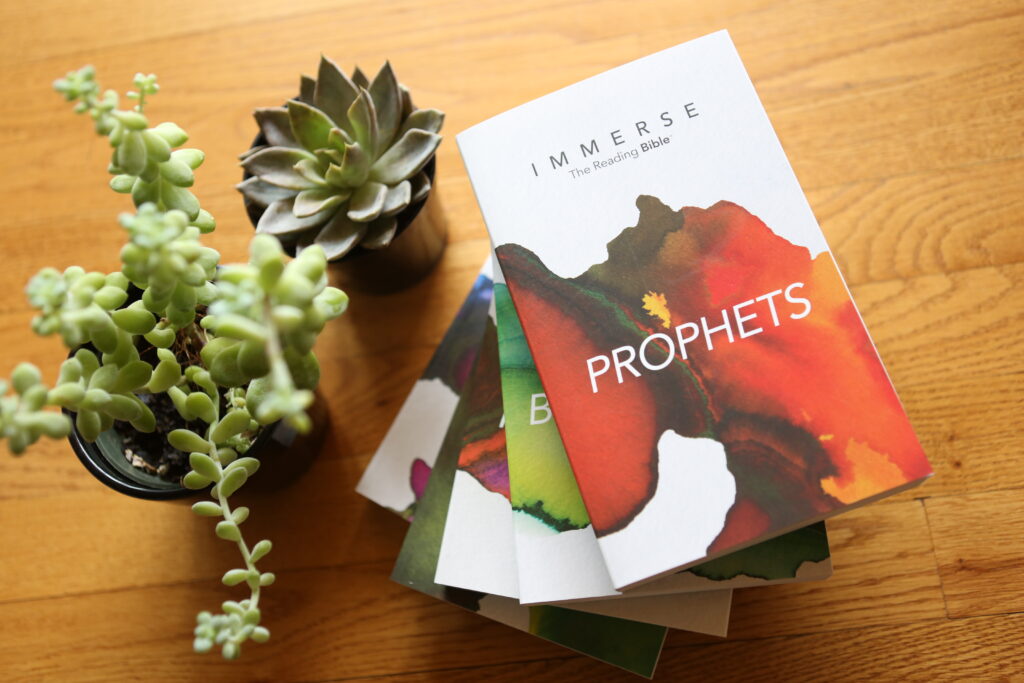
First, by collecting the books into six manageable volumes instead of one massive book, the intimidation factor is reduced.

Next, we placed the books in an order that makes more sense for good reading. For example, rather than using the size of books as an organizing principle (like in the prophets and Paul’s letters), we’ve put the books in those sections back into a better historical order. This allows readers to follow events in a chronological way and make more sense of things. We’ve also reunited books that were split into smaller books: Samuel–Kings, Chronicles–Ezra–Nehemiah, and Luke–Acts. In the New Testament, we’ve gathered books around each Gospel that naturally fit with that telling of Jesus’ story—for instance, Peter’s letters are now with Mark’s Gospel, and so forth with the other Gospels.

Then, in a crucial move to enhance better reading, we’ve removed all the modern additives. So there are no chapter and verse intrusions, no footnotes, no section headings or cross-references—all features that tend to distract readers and work against big, immersive reading of whole books. This allows us to present each book with its natural literary sections intact. So the five natural sections of Matthew’s new Torah can be clearly seen, letters look like letters, songs like songs, proverbs like proverbs, etc.—all across the literature of the Bible. This restores the Bible to the kinds of literary forms that authors chose and God inspired and helps us to have a more authentic interpretation.

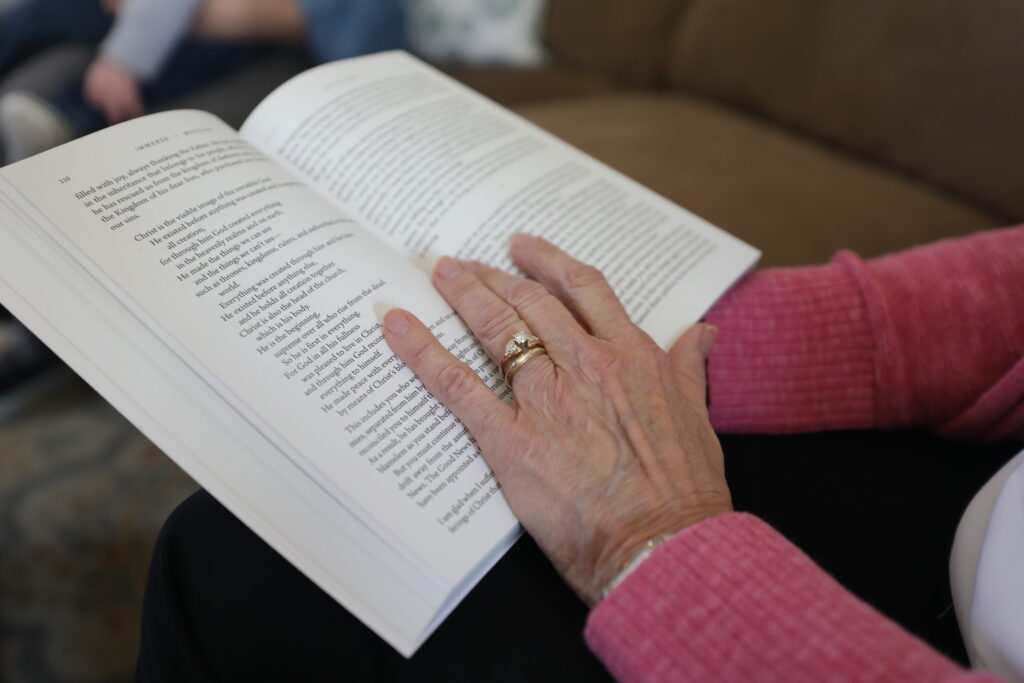
Finally, we’ve designed each page for easy and smooth reading. The single-column text, comfortable type size, and generous margins and line spacing—all surrounding the clear, straight-forward New Living Translation text—make for a significantly rich Bible reading experience.

What is your vision for normalizing Bible “book clubs,” and how are these different from Bible studies?

The original experiences of God’s people with the Bible were all communal experiences. Before the books were written down, ancient stories were being recounted and passed on to new generations; prophets were delivering their oracles openly and publicly at city gates and Temple entrances; and regular, ongoing Bible readings and discussions were organized in local synagogues. Traditions about Jesus were being told and retold in villages and early Christian gatherings. All of this was done in community.

Then, even when the Scriptures were first written, the copies were few in number and always read aloud in groups. Think of the apostles’ first letters to churches as an example. These would have been written down, transported, and then read to gathered followers of Jesus, most of whom were not literate. People overwhelmingly heard the Bible read, and they listened together.

It was only much later in church history that technological advances gave individuals the chance to have their own copy to read alone. Personal use of the Bible began to replace the previous communal experiences.

Personal reading of the Bible is, of course, a great thing, and none of us should stop that. But something different and very important happens when we read the Bible in community. It’s crucial to remember that the Bible’s own goal is the formation of a distinctive Christian community of people. It is addressed to communities and meant to be lived out as communities.

When we read and discuss the Bible together, we get beyond our own biases and filters. We get to hear how the sacred text impacts others. We see more and learn more. Our own personal understanding is enhanced. It is also important for us to practice the virtues (the fruit of the Spirit) required for true community. Patient listening, striving to understand the point of view of my neighbor, and shared learning are all critical parts of being a genuine Christ-following community.

Traditional Bible studies tend to focus on dissecting smaller parts of the Bible text. While there is certainly value in doing that, what’s been missing from the church’s experience with the Bible is taking in the messages of whole books and having bigger, more open-ended discussions about them.

A book club approach to our gatherings around the Bible is a fresh way for Christian communities to read, learn, and even struggle with the Bible together. And if we were to embrace this as a regular, ongoing pattern of the Christian life, we could begin to see more serious discipleship in understanding and following the way of Jesus. Not just in our personal lives, but our community presence is meant to be a witness to the coming of God’s gracious rule into the world.

The first vision of God’s people for engaging the Bible was a pattern of lectio continua—the continual (weekly or even daily) immersion of the community into whole books of the Bible. Ongoing penetration into the depths of God’s word allowed gatherings of believers to understand all that God had said before and to effectively live into the story in their own day. A re-envisioning of church life today—around deep engagement in the word of God—could strengthen our struggling churches and empower a new sense of identity and calling.

How do you think Immerse and the other work of the Institute for Bible Reading can help the church?

Once upon a time, God’s people were known as the People of the Book. Israel developed the only religion in the ancient world that was so deeply oriented toward a set of sacred texts. Then the earliest followers of Jesus, who were all Jewish and were shaped by this orientation, continued this profound commitment to reading, knowing, and living by the Scriptures.

The early church did whatever it took to make sure every new congregation of believers in the growing movement had access to the Scriptures and were regularly engaged with them. This happened in a world where 90% of the population was illiterate. The practice of reading through the Bible in regular cycles was brought from Judaism right into Christianity. At one point, being a lector, or Bible reader, was an official church office. It was considered essential in early Christianity that all of God’s people were consistently and significantly occupied with God’s word.

We have fallen from this. The work of the Institute for Bible Reading is geared toward helping the church regain this status and rediscover God’s story found in the Bible. We believe that a renewed commitment from church leaders, together with great new resources that surprise people with the Bible, are the things that can feed genuine renewal in the church. The Scriptures are infused with the power of God to bring real transformation into individual lives and into the life of the world. We believed and practiced it once, and we can do so again.

Learn more about Immerse: The Bible Reading Experience

Learn more about the Institute for Bible Reading

One Year Pray for America Bible

Reading from May 7th in the One Year Pray for America Bible

Lord, Hannah understood exactly who you are. When she prayed, “No one is holy like the Lord! There is no one besides you,” she nailed it (1 Samuel 2:2). May all who search for you—the powerful and the humble— recognize who you really are! Amen.

Prayer Prompt

1 SAMUEL 1:1–2:21
There was a man named Elkanah who lived in Ramah in the region of Zuph in the hill country of Ephraim. He was the son of Jeroham, son of Elihu, son of Tohu, son of Zuph, of Ephraim. Elkanah had two wives, Hannah and Peninnah. Peninnah had children, but Hannah did not.

Each year Elkanah would travel to Shiloh to worship and sacrifice to the Lord of Heaven’s Armies at the Tabernacle. The priests of the Lord at that time were the two sons of Eli—Hophni and Phinehas. On the days Elkanah presented his sacrifice, he would give portions of the meat to Peninnah and each of her children. And though he loved Hannah, he would give her only one choice portion because the Lord had given her no children. So Peninnah would taunt Hannah and make fun of her because the Lord had kept her from having children. Year after year it was the same—Peninnah would taunt Hannah as they went to the Tabernacle. Each time, Hannah would be reduced to tears and would not even eat.

“Why are you crying, Hannah?” Elkanah would ask. “Why aren’t you eating? Why be downhearted just because you have no children? You have
me—isn’t that better than having ten sons?”

Once after a sacrificial meal at Shiloh, Hannah got up and went to pray. Eli the priest was sitting at his customary place beside the entrance of the Tabernacle. Hannah was in deep anguish, crying bitterly as she prayed to the Lord. And she made this vow: “O Lord of Heaven’s Armies, if you will look upon my sorrow and answer my prayer and give me a son, then I will give him back to you. He will be yours for his entire lifetime, and as a sign that he has been dedicated to the Lord, his hair will never be cut.”

As she was praying to the Lord, Eli watched her. Seeing her lips moving but hearing no sound, he thought she had been drinking. “Must you come here drunk?” he demanded. “Throw away your wine!”

“Oh no, sir!” she replied. “I haven’t been drinking wine or anything stronger. But I am very discouraged, and I was pouring out my heart to the Lord. Don’t think I am a wicked woman! For I have been praying out of great anguish and sorrow.”

“In that case,” Eli said, “go in peace! May the God of Israel grant the request you have asked of him.”

“Oh, thank you, sir!” she exclaimed. Then she went back and began to eat again, and she was no longer sad.

The entire family got up early the next morning and went to worship the Lord once more. Then they returned home to Ramah. When Elkanah slept with Hannah, the Lord remembered her plea, and in due time she gave birth to a son. She named him Samuel, for she said, “I asked the Lord for him.”

The next year Elkanah and his family went on their annual trip to offer a sacrifice to the Lord and to keep his vow. But Hannah did not go. She told her husband, “Wait until the boy is weaned. Then I will take him to the Tabernacle and leave him there with the Lord permanently.”

“Whatever you think is best,” Elkanah agreed. “Stay here for now, and may the Lord help you keep your promise.” So she stayed home and nursed the boy until he was weaned. Hannah took him to the Tabernacle in Shiloh. They brought along a three-​year-​old bull for the sacrifice and a basket of flour and some wine. After sacrificing the bull, they brought the boy to Eli. “Sir, do you remember me?” Hannah asked. “I am the very woman who stood here several years ago praying to the Lord. I asked the Lord to give me this boy, and he has granted my request. Now I am giving him to the Lord, and he will belong to the Lord his whole life.” And they worshiped the Lord there.

Then Hannah prayed:
“My heart rejoices in the Lord!
The Lord has made me strong.
Now I have an answer for my enemies;
I rejoice because you
rescued me.
No one is holy like the Lord!
There is no one besides you;
there is no Rock like our God.
“Stop acting so proud and haughty!
Don’t speak with such arrogance!
For the Lord is a God who knows what you have done;
he will judge your actions. The bow of the mighty is now broken,
and those who stumbled are now strong.
Those who were well fed are now starving, and those who were starving are now full.
The childless woman now has seven children,
and the woman with many children wastes away.
The Lord gives both death and life;
he brings some down to the grave but raises others up.
The Lord makes some poor and others rich;
he brings some down and lifts others up.
He lifts the poor from the dust and the needy from the garbage dump.
He sets them among princes,
placing them in seats of honor.
For all the earth is the Lord’s,
and he has set the world in order.

“He will protect his faithful ones,
but the wicked will disappear in darkness.
No one will succeed by strength alone.
Those who fight against the Lord will be shattered.
He thunders against them from heaven;
the Lord judges throughout the earth.
He gives power to his king;
he increases the strength of his anointed one.”

Then Elkanah returned home to Ramah without Samuel. And the boy served the Lord by assisting Eli the priest.

Now the sons of Eli were scoundrels who had no respect for the Lord or for their duties as priests. Whenever anyone offered a sacrifice, Eli’s sons would send over a servant with a three-​pronged fork. While the meat of the sacrificed animal was still boiling, the servant would stick the fork into the pot and demand that whatever it brought up be given to Eli’s sons. All the Israelites who came to worship at Shiloh were treated this way. Sometimes the servant would come even before the animal’s fat had been burned on the altar. He would demand raw meat before it had been boiled so that it could be used for roasting.

The man offering the sacrifice might reply, “Take as much as you want, but the fat must be burned first.” Then the servant would demand, “No, give it to me now, or I’ll take it by force.” So the sin of these young men was very serious in the Lord’s sight, for they treated the Lord’s offerings with contempt.

But Samuel, though he was only a boy, served the Lord. He wore a linen garment like that of a priest. Each year his mother made a small coat for him and brought it to him when she came with her husband for the sacrifice. Before they returned home, Eli would bless Elkanah and his wife and say, “May the Lord give you other children to take the place of this one she gave to the Lord.” And the Lord blessed Hannah, and she conceived and gave birth to three sons and two daughters. Meanwhile, Samuel grew up in the presence of the Lord.

JOHN 5:1-23
Afterward Jesus returned to Jerusalem for one of the Jewish holy days. Inside the city, near the Sheep Gate, was the pool of Bethesda, with five covered porches. Crowds of sick people—blind,lame, or paralyzed—lay on the porches. One of the men lying there had been sick for thirty-​eight years. When Jesus saw him and knew he had been ill for a long time, he asked him, “Would you like to get well?”

“I can’t, sir,” the sick man said, “for I have no one to put me into the pool when the water bubbles up. Someone else always gets there ahead of me.” Jesus told him, “Stand up, pick up your mat, and walk!” Instantly, the man was healed! He rolled up his sleeping mat and began walking! But this miracle happened on the Sabbath, so the Jewish leaders objected. They said to the man who was cured, “You can’t work on the Sabbath! The law doesn’t allow you to carry that sleeping mat!”

But he replied, “The man who healed me told me, ‘Pick up your mat and walk.’”

“Who said such a thing as that?” they demanded.

The man didn’t know, for Jesus had disappeared into the crowd. But afterward Jesus found him in the Temple and told him, “Now you are well; so stop sinning, or something even worse may happen to you.” Then the man went and told the Jewish leaders that it was Jesus who had healed him. So the Jewish leaders began harassing Jesus for breaking the Sabbath rules. But Jesus replied, “My Father is always working, and so am I.” So the Jewish leaders tried all the harder to find a way to kill him. For he not only broke the Sabbath, he called God his Father, thereby making himself equal with God.

So Jesus explained, “I tell you the truth, the Son can do nothing by himself. He does only what he sees the Father doing. Whatever the Father does, the Son also does. For the Father loves the Son and shows him everything he is doing. In fact, the Father will show him how to do even greater works than healing this man. Then you will truly be astonished. For just as the Father gives life to those he raises from the dead, so the Son gives life to anyone he wants. In addition, the Father judges no one. Instead, he has given the Son absolute authority to judge, so that everyone will honor the Son, just as they honor the Father. Anyone who does not honor the Son is certainly not honoring the Father who sent him.”

PSALM 105:37-45
The Lord brought his people out of Egypt, loaded with silver and gold;
and not one among the tribes of Israel even stumbled.
Egypt was glad when they were gone,
For they feared them greatly.
The Lord spread a cloud above them as a covering
and gave them a great fire to light the darkness.
They asked for meat, and he sent them quail;
he satisfied their hunger with manna—bread from heaven.
He split open a rock, and water gushed out
to form a river through the dry wasteland.
For he remembered his sacred promise
to his servant Abraham.
So he brought his people out of Egypt with joy,
his chosen ones with rejoicing.
He gave his people the lands of pagan nations,
and they harvested crops that others had planted.
All this happened so they would follow his decrees
and obey his instructions.
Praise the Lord!

PROVERBS 14:28-29
A growing population is a king’s glory;
a prince without subjects has nothing.
People with understanding control their anger;
a hot temper shows great foolishness.

Want to read more? The December 2019 Read With Us plan is featuring the One Year Pray for America Bible. Every week you will receive links to the reading for the each day of the week. Sign up and join us.

Sampler One Year Pray for America Bible
Look Inside the
One Year Pray for America Bible

True Freedom in the Spirit

“So Christ has truly set us free. Now make sure that you stay free, and don’t get tied up again in slavery to the law. Listen! I, Paul, tell you this: If you are counting on circumcision to make you right with God, then Christ will be of no benefit to you. I’ll say it again. If you are trying to find favor with God by being circumcised, you must obey every regulation in the whole law of Moses. For if you are trying to make yourselves right with God by keeping the law, you have been cut off from Christ! You have fallen away from God’s grace.” Galatians 5:1-4, NLT

Taken from the Wayfinding Bible

As Paul continues his letter, he explains to the churches what it really means to live in Christ, free from the law. The burden of following the Jewish law has been lifted by Christ, who fulfilled the law entirely. This is the joy of Christianity. Paul writes that we are free to live out the love of God through the power of the Spirit, experiencing joy and peace as we trust in Christ completely for our salvation.

OBSERVATION POINT
The Galatians thought they would please God more if they followed the law while believing in Christ. They had it all wrong. Christ had freed them from the obligations of the law. By his grace, his free gift, they were saved. Salvation is free. God gives it to us out of love for us, not because of what he gets out of us in return. In response to his generosity, we live a life of gratitude and thanksgiving to glorify him.

EXPLORATION POINT
Christians are free from the law, but we do not have a license to keep on sinning. We have a choice, either to rely on the Holy Spirit or to yield to our sinful nature. The power of the Spirit within us will guide us to a life filled with peace, love, and joy. If we allow our sinful nature to dominate us, we will live in chaos, strife, and bitterness. We don’t have to battle sin on our own. We have the Spirit’s power to fight our sinful desires and to change our hearts to follow God’s will.

Wayfinding Bible
Look Inside the
Wayfinding Bible

Finding Roots in God’s Word

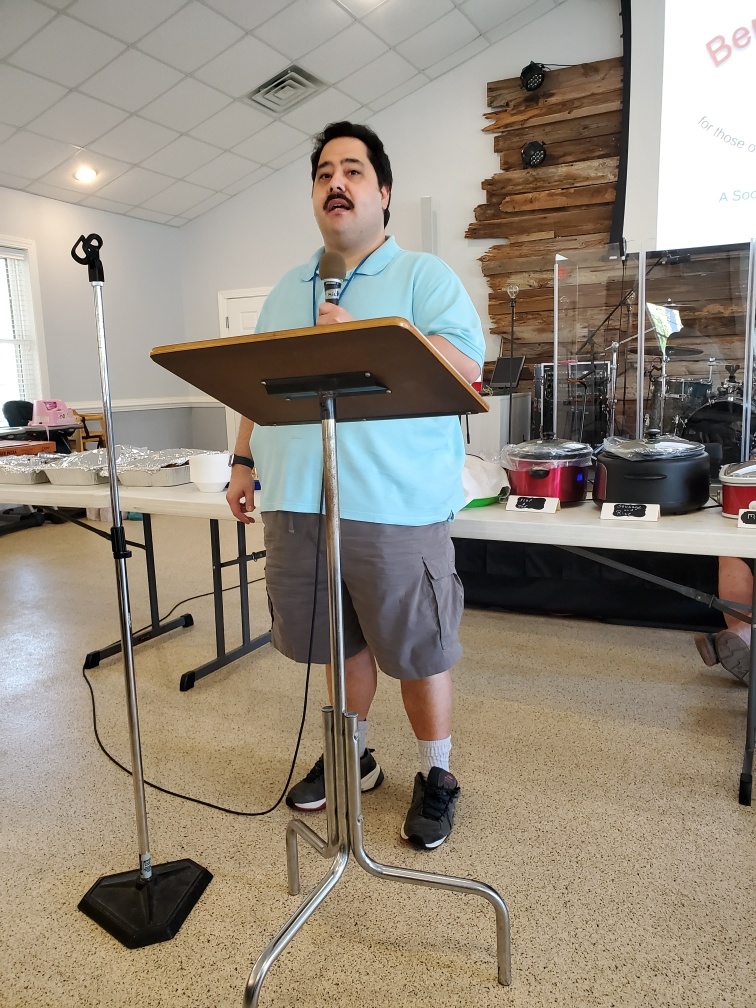
As the son of a marine, Joshua grew up moving from military base to military base. Rarely having time to catch his breath, let alone put down roots, he moved from one location to the next feeling alone and unable to connect, especially when it came to church. From talking to the base chaplain to going to local churches, he kept getting discouraged and gave up on church for several years. Until he found Cherry Point Baptist Church, a loving community that encouraged him to find out why he believed what he believed.

“After I was saved, I wanted to learn all that I could about the Bible. When I heard about the New Living Translation (NLT) my curiosity was piqued. Reading the NLT has brought a sense of vividness and clarity. I have read lots of translations, but keep coming back to the NLT,” said Joshua.

Joshua’s enthusiasm for God’s Word continues to grow and he can’t keep it to himself. He leads a multigenerational Bible study at his church and has become an active member in a local community feeding program.

“We live in a world filled with competing ideas. Not only reading but understanding the Bible helps people find their way. If they aren’t in the Bible, they are putting themselves at risk. I know, because it happened to me,” said Joshua.

From past experiences Joshua learned the importance of discernment and finding truth in God’s Word, not in the world around you. In his Bible study he helps others understand that too. It’s not only about reading the Word, it’s about studying it and applying it to our lives.

“Readability helps a person to understand what God is telling them. If a translation is hard to read and understand, I’ve seen people struggle when asked to read aloud or feel frustrated that they don’t understand. I’ve had that experience in my own study, finding myself mentally rephrasing or using a dictionary to try to understand some of the words. I wonder how many people have given up reading the Bible when faced with these issues?” said Joshua.

Making sure that doesn’t happen has become paramount to Joshua. The NLT is used every week in the Bible study Joshua leads to make concepts clear and help people feel confident while reading God’s Word. He has also found that the NLT is a great way to engage with people who attend a local feeding ministry.

Called Loaves and Fishes, this ministry invites community members to a free meal. Volunteers bring hot meals and desserts and they talk to people around the tables. The evening includes a short devotional, Scripture reading, and a time of prayer.

“I started attending as a visitor, and now I’m a volunteer. I give the devotional, but I also hand out plates, set up the tables, and help wherever I can. Just being a listening ear or extra pair of hands to someone who needs it is a powerful ministry,” said Joshua.

“Reading the NLT gives me a sense of peace. I feel I can turn off the distractions of the world around me and just pray, read, and ask God for wisdom,” said Joshua.

Explore New Living Translation Bibles

Vulnerability and Everyday Miracles

Devotional from the Beyond Suffering Bible

“One day the widow of a member of the group of prophets came to Elisha and cried out, ‘My husband who served you is dead, and you know how he feared the Lord. But now a creditor has come, threatening to take my two sons as slaves.”What can I do to help you?’ Elisha asked. ‘Tell me, what do you have in the house?”Nothing at all, except a flask of olive oil,’ she replied. And Elisha said, ‘Borrow as many empty jars as you can from your friends and neighbors. Then go into your house with your sons and shut the door behind you. Pour olive oil from your flask into the jars, setting each one aside when it is filled.’ So she did as she was told. Her sons kept bringing jars to her, and she filled one after another. Soon every container was full to the brim! ‘Bring me another jar,’ she said to one of her sons. ‘There aren’t any more!’ he told her. And then the olive oil stopped flowing. When she told the man of God what had happened, he said to her, ‘Now sell the olive oil and pay your debts, and you and your sons can live on what is left over.’” 2 Kings 4:1-7, NLT

In life, we manage changing circumstances, losses, pressures, and ambitions that make us vulnerable. Our bodies are susceptible to disease, abuse, and accidents. Our minds regularly cope with a wide range of emotions such as confusion, fear, anger, and trust. All of these can increase our sense of vulnerability in ways that can affect the rest of our lives.

A father of a young daughter with Down syndrome fears that she will grow up in a harsh and violent world. While he can’t be with her every minute, he longs to protect her so she can become the sociable, funny, loving woman of faith that God created her to be.

In the story recounted in 2 Kings 4:1‑7, a husband’s death brought economic hardship, poverty, and suffering to his wife. She became vulnerable to creditors, and if she failed to pay, her two sons would be taken as slaves (4:1). There was no governmental assistance, insurance policy, or benefit system to save them.

She sought out the prophet Elijah, who offered help. He began by asking what she had in the house. He concentrated on what she had, not on what she lacked. She had nothing except a flask of olive oil (4:2). Next, he involved the close community around her by instructing her to borrow as many jars as possible from her neighbors (4:3). She filled the jars to the brim until there were no more jars left, and the oil stopped flowing (4:5‑6). Then Elisha told her to sell the oil, pay off the debts, and live on what was left over.

What God did for this widow happens often in the lives of his followers. When we’re stressed and filled with anxiety, God’s Word offers practical guidance. His miracles frequently make use of the resources we have right in front of us. Be careful not to miss the miraculous in the middle of the ordinary!

BeyondSuffering Interior2C singlePages crop
Look Inside the
Beyond Suffering Bible

The Character of God

Note from the Christian Basics Bible

“Then the Lord came down in a cloud and stood there with him; and he called out his own name, Yahweh. The Lord passed in front of Moses, calling out, ‘Yahweh! The Lord! The God of compassion and mercy! I am slow to anger and filled with unfailing love and faithfulness.'” Exodus 34:5-6, NLT.

While people often say that the God of the Old Testament seems so different from the God of the New Testament, nothing could be further from the truth. We probably already associate Jesus with compassion, but here in Exodus 32–34 is a story that clearly declares how God revealed himself as the God of compassion in Old Testament times too.

While Moses was up on Mount Sinai, Aaron had made a gold calf, which Israel worshiped in a wild party (Exodus 32:1-8). God was rightly angry with them (though his anger is not like our anger; it is the right and just response of a holy God to wickedness). They had broken a fundamental aspect of the covenant—to have no gods other than him—and so deserved his judgment.

Yet even here we see God’s compassion, mercy, and patience. In swift response to Moses’ prayer, God forgave them (32:14), and when he called Moses up Sinai once again, he showed him what he was really like: “Yahweh! The Lord! The God of compassion and mercy! I am slow to anger and filled with unfailing love and faithfulness. I lavish unfailing love to a thousand generations. I forgive iniquity, rebellion, and sin” (34:6-7)—a revelation that utterly transformed Moses (34:29-35).

This absolute conviction that God was compassionate and merciful, always patient with his people, became an underlying theme of the Old Testament (e.g., 2 Chronicles 30:9; Nehemiah 9:17; Psalm 86:15; 103:8-18; Joel 2:13; Jonah 4:2).

Christian Basics Bible Sampler
Look Inside the
Christian Basics Bible

Video Story: Immerse Brings Unity to Multilingual Congregation

One of the most beautiful aspects of being a part of God’s family is that no matter our background, race, culture, nationality, or education level, we are all children of God. The Bethesda Community Church in Fort Worth, TX, is a thriving multigenerational, multicultural, multilingual congregation. Though united in love for God and each other, the congregation of English and Spanish speakers were looking for a way to grow together in community as well as in understanding God’s Word. Immerse: The Bible Reading Experience was a perfect fit. With all six volumes and resources available in both English and Spanish, the Bethesda family is growing close to God and each other by studying his Word.

Hear from members of the Spanish congregation about their experience. (The video includes English speakers and has English subtitles when the speaker uses Spanish.)

Learn more about Immerse: The Bible Reading Experience

The Bible’s Story is for Everyone

by Glenn Paauw, Senior Direct of Content for the Institute for Bible Reading

At the heart of the Gospel is the stunning realization that God is creating a new worldwide family through Jesus. The First Testament is the story of Israel – the Family of Abraham. God launches his project to restore the world by making Abraham a big promise. “This is my covenant with you: I will make you the father of a multitude of nations! I will confirm my covenant with you and your descendants after you, from generation to generation. . . . I will always be your God and the God of your descendants after you.” Since their inception, the nation of Israel knew that they were God’s family.

This is the story that Jesus was born into – the long, winding, up-and-down story of Israel. Then surprisingly, shockingly, Jesus fulfilled God’s promise to Abraham by giving up his life for the life of the world. Israel’s story became everyone’s story. All people are now invited to join God’s family, and the boundary lines that formerly ordered society – nationality, language, economic status, gender – are now superseded by membership in the family of God.

This means the Story of the Bible is the story we’ve all been adopted into. It’s our Family Story.

This beautiful reality is why we at the Institute for Bible Reading believe everyone should be welcomed to the table to feast together on the Word of God. And we intentionally crafted Immerse: The Bible Reading Experience to allow for that.

We were thrilled to hear how Bethesda Community Church used Immerse to create unity between their Spanish and English congregations (watch video story). They used the Family Guide to invite families with young children to read and discuss together. They (and others) have used the custom Immerse Audio edition for those who struggle to read or simply prefer to listen.

We realize there’s still a long way to go: more languages, more resources, and more adaptability for every kind of context. But our vision is for everyone to have the tools to read big, read real, and read together. This vision for God’s new family to go deep into God’s Word is already beginning to happen.

The Kingdom of God is brown, white, black, young, old, educated, uneducated, healthy, disabled, rich, poor, and everything in between. We speak a multitude of languages. But we are united in Christ. What a beautiful gift it is to come together and feast on our Story.

Learn more about Immerse: The Bible Reading Experience

Learn more about the Institute for Bible Reading

Retreat and Return

“About eight days later Jesus took Peter, John, and James up on a mountain to pray. And as he was praying, the appearance of his face was transformed, and his clothes became dazzling white. Suddenly, two men, Moses and Elijah, appeared and began talking with Jesus. They were glorious to see. And they were speaking about his exodus from this world, which was about to be fulfilled in Jerusalem. Peter and the others had fallen asleep. When they woke up, they saw Jesus’ glory and the two men standing with him. As Moses and Elijah were starting to leave, Peter, not even knowing what he was saying, blurted out, ‘Master, it’s wonderful for us to be here! Let’s make three shelters as memorials—one for you, one for Moses, and one for Elijah.’ But even as he was saying this, a cloud overshadowed them, and terror gripped them as the cloud covered them. Then a voice from the cloud said, ‘This is my Son, my Chosen One. Listen to him.’ When the voice finished, Jesus was there alone. They didn’t tell anyone at that time what they had seen.” Luke 9:28-36, NLT

Peter, James, and John had such an amazing time with Jesus up on a mountain that they didn’t want to leave. Have you ever been to a youth retreat or had a time with God that was so cool you didn’t want it to end?

Being away from the reality and problems of our daily life can seem inviting. But we can’t stay on a mountaintop forever. Instead of becoming spiritual giants, we would soon become giants of self-centeredness.

We need times of retreat and renewal but only so we can return to help build up our family and friends. Our faith must make sense off the mountain as well as on it.

Note from the Girls Life Application Study Bible

girls lasb sampler howto john single pages
Look Inside the Girls Life Application Study Bible