Where Is God In Suffering? Day 5

“So you have not received a spirit that makes you fearful slaves. Instead, you received God’s Spirit when he adopted you as his own children. Now we call him, ‘Abba, Father.’ For his Spirit joins with our spirit to affirm that we are God’s children. And since we are his children, we are his heirs. In fact, together with Christ we are heirs of God’s glory. But if we are to share his glory, we must also share his suffering.

Yet what we suffer now is nothing compared to the glory he will reveal to us later. For all creation is waiting eagerly for that future day when God will reveal who his children really are. Against its will, all creation was subjected to God’s curse. But with eager hope, the creation looks forward to the day when it will join God’s children in glorious freedom from death and decay. For we know that all creation has been groaning as in the pains of childbirth right up to the present time. And we believers also groan, even though we have the Holy Spirit within us as a foretaste of future glory, for we long for our bodies to be released from sin and suffering. We, too, wait with eager hope for the day when God will give us our full rights as his adopted children, including the new bodies he has promised us. We were given this hope when we were saved. (If we already have something, we don’t need to hope for it. But if we look forward to something we don’t yet have, we must wait patiently and confidently.)

And the Holy Spirit helps us in our weakness. For example, we don’t know what God wants us to pray for. But the Holy Spirit prays for us with groanings that cannot be expressed in words. And the Father who knows all hearts knows what the Spirit is saying, for the Spirit pleads for us believers in harmony with God’s own will. And we know that God causes everything to work together for the good of those who love God and are called according to his purpose for them. For God knew his people in advance, and he chose them to become like his Son, so that his Son would be the firstborn among many brothers and sisters. And having chosen them, he called them to come to him. And having called them, he gave them right standing with himself. And having given them right standing, he gave them his glory.” Romans 8:15-30, NLT

Notes from the Wayfinding Bible

Paul certainly doesn’t hold back on the topic of sin and its consequences, but he doesn’t leave the Romans to despair over their sinfulness either. He reminds them that, through Christ, God has dealt decisively with sin. Paul brings them to a point of celebration by focusing on the joy that comes with faith and the peace that comes with life in the Holy Spirit.

When Paul talks about our sinful nature, he is referring to the inclination of our natural desires toward sin. All humans are born with a sinful nature. God, however, did not create people this way. He created them perfect, without sin; but sin came into the world through Adam and Eve, who disobeyed God. Humans are sinful and God is perfect; we need Jesus to make us sinless again in God’s eyes.

Paul’s message to the Romans contains one of the most comforting passages in the Bible. He clearly states, in different ways, that nothing can separate us from God’s love. He gives us comfort and assurance that no matter what we do, where we go, or what happens to us, absolutely nothing will come between us and God’s love for us. We are super glued to God, and nothing can rip us out of his loving arms.

Look inside the Wayfinding Bible

Where is God In Suffering: Day 4

“’In a little while you won’t see me anymore. But a little while after that, you will see me again.’

Some of the disciples asked each other, ‘What does he mean when he says, ‘In a little while you won’t see me, but then you will see me,’ and ‘I am going to the Father’? And what does he mean by ‘a little while’? We don’t understand.’

Jesus realized they wanted to ask him about it, so he said, “Are you asking yourselves what I meant? I said in a little while you won’t see me, but a little while after that you will see me again. I tell you the truth, you will weep and mourn over what is going to happen to me, but the world will rejoice. You will grieve, but your grief will suddenly turn to wonderful joy. It will be like a woman suffering the pains of labor. When her child is born, her anguish gives way to joy because she has brought a new baby into the world. So you have sorrow now, but I will see you again; then you will rejoice, and no one can rob you of that joy. At that time you won’t need to ask me for anything. I tell you the truth, you will ask the Father directly, and he will grant your request because you use my name. You haven’t done this before. Ask, using my name, and you will receive, and you will have abundant joy.

‘I have spoken of these matters in figures of speech, but soon I will stop speaking figuratively and will tell you plainly all about the Father. Then you will ask in my name. I’m not saying I will ask the Father on your behalf, for the Father himself loves you dearly because you love me and believe that I came from God. Yes, I came from the Father into the world, and now I will leave the world and return to the Father.”

Then his disciples said, ‘At last you are speaking plainly and not figuratively. Now we understand that you know everything, and there’s no need to question you. From this we believe that you came from God.’

Jesus asked, ‘Do you finally believe? But the time is coming—indeed it’s here now—when you will be scattered, each one going his own way, leaving me alone. Yet I am not alone because the Father is with me. I have told you all this so that you may have peace in me. Here on earth you will have many trials and sorrows. But take heart, because I have overcome the world.” John 16:16-33, NLT

Note from the Every Man’s Bible

In this world, we will encounter “many trials and sorrows.” Some of these difficulties are inevitable and beyond our control. These can be endured with God’s help. On the other hand, some of our suffering is self- inflicted and can be avoided.

In such situations, God still offers us peace as we muster the courage to make needed changes in our lives. God’s forgiveness and loving acceptance can give us peace as we face our trials and sorrows, even when the pain we face is ultimately our own fault. He has the power to lead us down the path of life; he has already overcome all the obstacles that stand in our way.

Look inside the Every Man’s Bible

Where Is God In Suffering? Day 3

“This is what the Lord says:

‘At just the right time, I will respond to you.
On the day of salvation I will help you.
I will protect you and give you to the people
as my covenant with them.
Through you I will reestablish the land of Israel
and assign it to its own people again.

I will say to the prisoners, ‘Come out in freedom,’
and to those in darkness, ‘Come into the light.’
They will be my sheep, grazing in green pastures and on hills that were previously bare.

They will neither hunger nor thirst.
The searing sun will not reach them anymore.
For the Lord in his mercy will lead them;
he will lead them beside cool waters.

And I will make my mountains into level paths for them.
The highways will be raised above the valleys.
See, my people will return from far away,
from lands to the north and west,
and from as far south as Egypt.’

Sing for joy, O heavens!
Rejoice, O earth!
Burst into song, O mountains!
For the Lord has comforted his people
and will have compassion on them in their suffering.” Isaiah 49:8-13, NLT

Note from the Africa Study Bible

This passage described the time when the Jewish exiles were in a hopeless situation in Babylon. Their future seemed very dark with no hope of returning to their homeland. Isaiah prophesied that God would intervene in much the same way he did when he brought them out of Egypt. Once again they would return to their own land. Isaiah described a Servant through whom God would fulfil his promises to Israel (Isaiah 49:5). What is most striking in Isaiah’s prophecy is this Servant—Jesus—would not only restore Israel, but also the Gentiles (Isaiah 49:6). This was in fulfilment of God’s promise to Abraham that “all the families of the earth will be blessed through you” (Genesis 12:3).

In Christ, we see the love of God for all peoples and his plan to save people from all nations. Christ tells his followers to fulfil his plan by making disciples of all nations (Matthew 28:18). All Christians—not only missionaries or pastors or deacons—are part of bringing salvation to the nations. God’s Servant gives freedom to the prisoners, brings light to people in darkness, restores all of God’s people, and restores all of God’s creation.

We are called to be part of that effort. The world may seem hopeless, but the fact that Christians are in this broken world means that God is still at work. Let us regularly join with other Christians to pray for people of other nations who need physical and spiritual salvation.

Look inside the Africa Study Bible

Where is God in Suffering? Day 1

“Elihu continued speaking: ‘Let me go on, and I will show you the truth.

For I have not finished defending God!
I will present profound arguments
for the righteousness of my Creator.
I am telling you nothing but the truth,
for I am a man of great knowledge.

‘God is mighty, but he does not despise anyone!
He is mighty in both power and understanding.
He does not let the wicked live
but gives justice to the afflicted.
He never takes his eyes off the innocent,
but he sets them on thrones with kings
and exalts them forever.
If they are bound in chains
and caught up in a web of trouble,
he shows them the reason.
He shows them their sins of pride.
He gets their attention
and commands that they turn from evil.

‘If they listen and obey God,
they will be blessed with prosperity throughout their lives.
All their years will be pleasant.
But if they refuse to listen to him,
they will cross over the river of death,
dying from lack of understanding.
For the godless are full of resentment.
Even when he punishes them,
they refuse to cry out to him for help.
They die when they are young,
after wasting their lives in immoral living.
But by means of their suffering, he rescues those who suffer.
For he gets their attention through adversity.

‘God is leading you away from danger, Job,
to a place free from distress.
He is setting your table with the best food.
But you are obsessed with whether the godless will be judged.
Don’t worry, judgment and justice will be upheld.
But watch out, or you may be seduced by wealth.
Don’t let yourself be bribed into sin.
Could all your wealth
or all your mighty efforts
keep you from distress?
Do not long for the cover of night,
for that is when people will be destroyed.
Be on guard! Turn back from evil,
for God sent this suffering
to keep you from a life of evil.'”

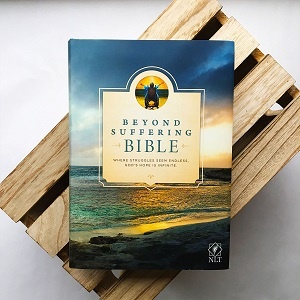
Note from the Beyond Suffering Bible

Sanctification:

Job’s suffering did not prove that Job was wicked or sinful, but it did introduce a central issue: During times of suffering and disability, when anger and doubt arise that lead to accusations against God’s goodness, God is at work in his own ways to shape and refine his people. We need to be attentive to what God is—and isn’t—saying to us, and not let our pride or worldly assumptions obscure his purposes and timing in our lives.

Take a look inside the Beyond Suffering Bible

God’s Healing Hand Day 6

“Peter and John went to the Temple one afternoon to take part in the three o’clock prayer service. As they approached the Temple, a man lame from birth was being carried in. Each day he was put beside the Temple gate, the one called the Beautiful Gate, so he could beg from the people going into the Temple. When he saw Peter and John about to enter, he asked them for some money.

Peter and John looked at him intently, and Peter said, ‘Look at us!’ The lame man looked at them eagerly, expecting some money. But Peter said, ‘I don’t have any silver or gold for you. But I’ll give you what I have. In the name of Jesus Christ the Nazarene, get up and walk!’

Then Peter took the lame man by the right hand and helped him up. And as he did, the man’s feet and ankles were instantly healed and strengthened. He jumped up, stood on his feet, and began to walk! Then, walking, leaping, and praising God, he went into the Temple with them.

All the people saw him walking and heard him praising God. When they realized he was the lame beggar they had seen so often at the Beautiful Gate, they were absolutely astounded! They all rushed out in amazement to Solomon’s Colonnade, where the man was holding tightly to Peter and John.” Acts 3:1-11, NLT

Notes from the Wayfinding Bible

Throughout the big story God has revealed his power through miracles. He showed his control over nature through the ten plagues in Egypt and by dividing the waters of the Red Sea. He provided food and water for his people while they wandered in the wilderness. He displayed his power through the Old Testament prophets and, most clearly, in his Son Jesus. Now that same power is with the apostles. The apostle Peter, one of Jesus’ original twelve disciples, continues the tradition of performing miracles, displaying God’s power in Christ’s name. He then boldly preaches in the Temple about Jesus’ life and death.

In Jewish society, imperfection of any kind made a person an outcast. In the Old Testament, God commanded his people to sacrifice only animals that “have no defect of any kind” (Leviticus 22:21). God also required priests to be without blemish. God’s law held other people to a high standard as well, but over the centuries Jewish culture had generalized these rules in a was that was harsh and unrealistic. A person had to be practically perfect to be part of the Jewish community. Peter’s healing was a great gift. It restored this man physically and socially.

Peter and John had been empowered by the Holy Spirit and were energized to see God working through them to spread the Good News. God’s power flowed through them so that Peter even healed a lame man in the name of Jesus Christ. This is a wonderful example of how God can do more than we can ask or imagine. The beggar was merely hoping for a coin or two to help him survive one more day. The possibility of being whole again and walking out of the Temple didn’t even enter his mind. But it happened. God can, will, and does do what we perceive as impossible.

Look inside the Wayfinding Bible

God’s Hand of Healing Day 4

“Jesus left Tyre and went up to Sidon before going back to the Sea of Galilee and the region of the Ten Towns. A deaf man with a speech impediment was brought to him, and the people begged Jesus to lay his hands on the man to heal him.

Jesus led him away from the crowd so they could be alone. He put his fingers into the man’s ears. Then, spitting on his own fingers, he touched the man’s tongue. Looking up to heaven, he sighed and said, ‘Ephphatha,’ which means, ‘Be opened!’ Instantly the man could hear perfectly, and his tongue was freed so he could speak plainly!

Jesus told the crowd not to tell anyone, but the more he told them not to, the more they spread the news. They were completely amazed and said again and again, ‘Everything he does is wonderful. He even makes the deaf to hear and gives speech to those who cannot speak.'” Mark 7:31-37, NLT

Notes from the Illustrated Study Bible

This miracle is very similar in order and vocabulary to the healing of the blind man in 8:22-26. Healing miracles in the Gospels follow a similar pattern—the constant telling and retelling of similar stories probably standardized their form and wording.

This healing miracle includes a change of scene. Although some interpret the next miracle as occurring in the Gentile world (Sidon or Decapolis), it probably took place after Jesus returned to the Sea of Galilee. The next incident takes place there (8:10) without a change of scene.

Jesus also used saliva in a healing at Mark 8:23, where he spit on a man’s eyes in curing his blindness. The medicinal use of saliva in ancient times is well documented.

Since Jesus was looking up to heaven when he sighed, his sigh is probably best understood as a prayerful gesture. Ephphatha is an Aramaic term that Mark translates for his readers (see also 3:17; 5:41; 14:36; 15:34). These are not magical formulas or incantations; Mark is simply recounting some of the original words Jesus spoke. Matthew and Luke do not seem to have attributed any special significance to the Aramaic words of Jesus, since they did not include them in their Gospels.

Despite his desire to avoid attention, Jesus’ greatness shone too brightly—his person, his teaching, and his ability to heal inspired awe, and he could not be hidden.

Look inside the Illustrated Study Bible

God’s Hand of Healing: Day 3

“The king of Aram had great admiration for Naaman, the commander of his army, because through him the Lord had given Aram great victories. But though Naaman was a mighty warrior, he suffered from leprosy.

At this time Aramean raiders had invaded the land of Israel, and among their captives was a young girl who had been given to Naaman’s wife as a maid. One day the girl said to her mistress, ‘I wish my master would go to see the prophet in Samaria. He would heal him of his leprosy.’

So Naaman told the king what the young girl from Israel had said. ‘Go and visit the prophet,’ the king of Aram told him. ‘I will send a letter of introduction for you to take to the king of Israel.’ So Naaman started out, carrying as gifts 750 pounds of silver, 150 pounds of gold, and ten sets of clothing. The letter to the king of Israel said: ‘With this letter I present my servant Naaman. I want you to heal him of his leprosy.’

When the king of Israel read the letter, he tore his clothes in dismay and said, ‘Am I God, that I can give life and take it away? Why is this man asking me to heal someone with leprosy? I can see that he’s just trying to pick a fight with me.’

But when Elisha, the man of God, heard that the king of Israel had torn his clothes in dismay, he sent this message to him: ‘Why are you so upset? Send Naaman to me, and he will learn that there is a true prophet here in Israel.’

So Naaman went with his horses and chariots and waited at the door of Elisha’s house. But Elisha sent a messenger out to him with this message: ‘Go and wash yourself seven times in the Jordan River. Then your skin will be restored, and you will be healed of your leprosy.’

But Naaman became angry and stalked away. ‘I thought he would certainly come out to meet me!’ he said. ‘I expected him to wave his hand over the leprosy and call on the name of the Lord his God and heal me! Aren’t the rivers of Damascus, the Abana and the Pharpar, better than any of the rivers of Israel? Why shouldn’t I wash in them and be healed?’ So Naaman turned and went away in a rage.

But his officers tried to reason with him and said, ‘Sir, if the prophet had told you to do something very difficult, wouldn’t you have done it? So you should certainly obey him when he says simply, ‘Go and wash and be cured!’” So Naaman went down to the Jordan River and dipped himself seven times, as the man of God had instructed him. And his skin became as healthy as the skin of a young child, and he was healed!

Then Naaman and his entire party went back to find the man of God. They stood before him, and Naaman said, ‘Now I know that there is no God in all the world except in Israel. So please accept a gift from your servant.'” 2 Kings 5:1-15, NLT

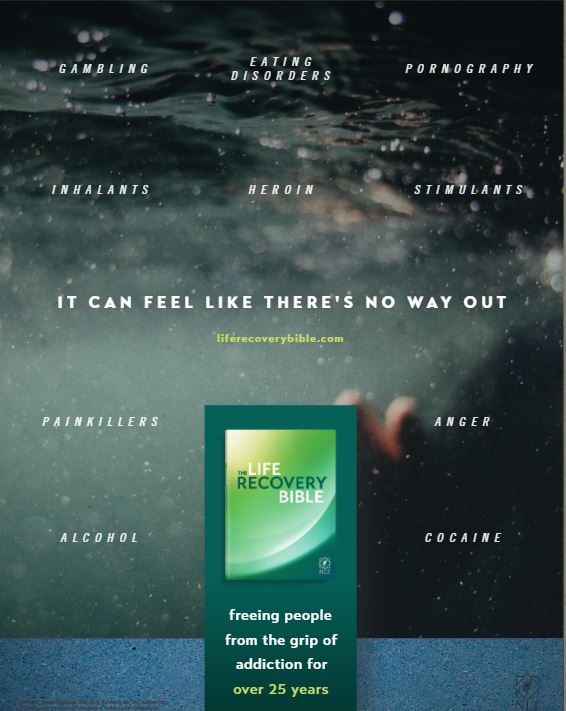
12-Step Devotional from the Life Recovery Bible

Step 1: We admitted that we were powerless Over our problems—that our lives had become unmanageable.


It can be very humiliating to admit that we are powerless, especially if we are used to being in control. We may be powerful in some areas of our lives, but out of control in terms of our addictive/compulsive behaviors. If we refuse to admit our powerlessness, we may lose everything. That one unmanageable part may infect and destroy everything else.

The experiences of Aramean army commander Naaman illustrate how this is true. He was a powerful military and political figure, a man of wealth, position, and power. He also had leprosy, which promised to bring about the loss of everything he held dear. Lepers were made outcasts from their families and from society. Ultimately, they faced a slow, painful, and disgraceful death.

Naaman heard about a prophet in Israel who could heal him. He found the prophet, and the prophet told him that in order to be healed he needed to dip himself seven times in the Jordan River. Naaman went away outraged, having expected that his power would buy him an instant and easy cure. In the end, however, he acknowledged his powerlessness, followed the instructions, and recovered completely.

Our “diseases” are as life threatening as the leprosy of Naaman’s day. They
slowly separate us from our families and lead toward the destruction of everything important to us. There is no instant or easy cure. The only answer is to admit our powerlessness, humble ourselves, and submit to the process that will eventually bring recovery.

Take a look inside the Life Recovery Bible

Be an Example

“Teach these things and insist that everyone learn them. Don’t let anyone think less of you because you are young. Be an example to all believers in what you say, in the way you live, in your love, your faith, and your purity.” 1 Timothy 4:11-12, NLT

Notes from the Life Application Study Bible

Timothy was a young pastor. It would have been easy for older Christians to look down on him because of his youth. He had to earn the respect of his elders by setting an example in his speech, life, love, faith, and purity. Regardless of your age, God can use you. Whether you are young or old, don’t think of your age as a handicap. Live so others can see Christ in you.

Apparently Timothy needed some encouragement. Most likely, so do you and others around you. Each day we have opportunities to support and inspire family members, fellow workers, friends, neighbors, pastors, and even total strangers. People need help and affirmation in their daily lives. Paul modeled five important principles to help us encourage others:

  1. Begin with positive statements. People who know we will speak kindly to them will be happy to work with us.
  2. Develop expectations of others with consideration for their skills, maturity, and experience. People will reject or fail to meet expectations that do not fit them. Be patient with distracted or slow learners.
  3. Monitor your expectations of others. Changing circumstances sometimes require revised or reduced expectations.
  4. Clarify your expectations with others. People are not likely to hit a target that no one has identified.
  5. End with a statement of gratitude. People love to be thanked for a job well done.

See the Personality Profile of Timothy from the Life Application Study Bible, Third Edition

The Life Application Study Bible, Third Edition, is available in Personal Size, Full Size, and Large Print. Learn more

God’s Hand of Healing: Day 2

“Some time later the woman’s son became sick. He grew worse and worse, and finally he died. Then she said to Elijah, ‘O man of God, what have you done to me? Have you come here to point out my sins and kill my son?’

But Elijah replied, ‘Give me your son.’ And he took the child’s body from her arms, carried him up the stairs to the room where he was staying, and laid the body on his bed. Then Elijah cried out to the Lord, ‘O Lord my God, why have you brought tragedy to this widow who has opened her home to me, causing her son to die?’

And he stretched himself out over the child three times and cried out to the Lord, ‘O Lord my God, please let this child’s life return to him.’ The Lord heard Elijah’s prayer, and the life of the child returned, and he revived! Then Elijah brought him down from the upper room and gave him to his mother. ‘Look!’ he said. ‘Your son is alive!’

Then the woman told Elijah, ‘Now I know for sure that you are a man of God, and that the Lord truly speaks through you.'” 1 Kings 17:17-24, NLT

Elijah Profile from the Beyond Suffering Bible

Asking others for help is humbling and can be life changing for everyone involved. If the person you ask has little available to give, your request may seem selfish or insensitive. But what if God told you to ask that person for assistance?

Elijah had a word from God directing him to go to Zarephath, where he would meet an impoverished widow and single mother who had no way of knowing that God was about to set in motion a miracle—one that would not only provide for her needs, but also impact her faith forever.

This story plays out in three acts.

Act One. Elijah instructed the widow to use her meager supplies of flour and cooking oil to bake some bread to feed him first, then her and her son. Elijah acted with God’s assurance that there would be enough food from that day until the new rains and crops arrived (17:14). The widow followed the prophet’s instructions, and there was just enough flour and oil to meet their daily needs. The promise of God was fulfilled.

Act Two. When the widow’s son became sick and died, the desperate woman turned to Elijah for help. He carried the child to his own room, where he prayed. Elijah’s first prayer was a complaint: “Why bring this tragedy on a poor woman who is simply struggling to stay alive? How can this be fair?” His second prayer was a request: “Give back the child’s life.” And God did.

Act Three. The grieving mother was given back a healthy, living son. The woman’s response went beyond simple joy or relief—she acknowledged the activity of God in the life and words of his prophet. Elijah was obedient, willing to trust God and humble himself to ask for help, even when it made no sense. The result? An abundant provision came through an unlikely source, and a struggling woman’s faith was strengthened.

Look inside the Beyond Suffering Bible

God’s Hand of Healing: Day 1

“When Isaac grew up and was about to be weaned, Abraham prepared a huge feast to celebrate the occasion. But Sarah saw Ishmael—the son of Abraham and her Egyptian servant Hagar—making fun of her son, Isaac. So she turned to Abraham and demanded, ‘Get rid of that slave woman and her son. He is not going to share the inheritance with my son, Isaac. I won’t have it!’

This upset Abraham very much because Ishmael was his son. But God told Abraham, ‘Do not be upset over the boy and your servant. Do whatever Sarah tells you, for Isaac is the son through whom your descendants will be counted. But I will also make a nation of the descendants of Hagar’s son because he is your son, too.’

So Abraham got up early the next morning, prepared food and a container of water, and strapped them on Hagar’s shoulders. Then he sent her away with their son, and she wandered aimlessly in the wilderness of Beersheba.

When the water was gone, she put the boy in the shade of a bush. Then she went and sat down by herself about a hundred yards away. ‘I don’t want to watch the boy die,’ she said, as she burst into tears.

But God heard the boy crying, and the angel of God called to Hagar from heaven, ‘Hagar, what’s wrong? Do not be afraid! God has heard the boy crying as he lies there. Go to him and comfort him, for I will make a great nation from his descendants.’

Then God opened Hagar’s eyes, and she saw a well full of water. She quickly filled her water container and gave the boy a drink.

And God was with the boy as he grew up in the wilderness. He became a skillful archer, and he settled in the wilderness of Paran. His mother arranged for him to marry a woman from the land of Egypt.” Genesis 21:8-21, NLT

Hagar Personality Profile from the Life Application Study Bible, Third Edition

Escape of some kind is often the most tempting solution to our problems. Hagar was a person who used that approach. When the going got tough, she got going—in the other direction.

However, it is worthwhile to note that the biggest challenges Hagar faced were brought on by other people’s choices. Sarah chose her to bear Abraham’s child, and Hagar probably had little say in the matter.

It isn’t hard to understand how Hagar’s pregnancy caused her to look down on Sarah. But that brought on hard feelings, and Sarah consequently punished Hagar. This motivated her first escape. When she returned to the family and gave birth to Ishmael, Sarah’s continued infertility must have contributed to bitterness on both sides.

When Isaac was finally born, Sarah looked for any excuse to have Hagar and Ishmael sent away. She found it when she caught Ishmael teasing Isaac. In the wilderness, out of water and facing the death of her son, Hagar once again tried to escape. She walked away so she wouldn’t have to watch her son die. Once again, God graciously intervened.

Have you noticed how patiently God operates to make our escape attempts fail? Have you begun to learn that escape is only a temporary solution? God’s continual desire is for us to face our problems with his help. We experience his help most clearly in and through conflicts and difficulties, not away from them. Are there problems in your life for which you’ve been using the “Hagar solution”? Choose one of those problems, ask for God’s help, and begin to face it today.

Take a look inside the Life Application Study Bible