Article from the Life Application Study Bible, Third Edition
Several psalms shock those familiar with New Testament teachings. The psalmists didn’t hesitate to demand God’s justice and make vivid suggestions on how he might carry it out. Apparently, no subject was unsuitable for discussion with God, but our tendency is to avoid the subjects of anger and vengeance in the book of Psalms.
To understand the psalm writers’ words of anger and vengeance, we need to understand several things:
The judgments asked for were to be carried out by God and were written out of intense personal and national suffering. The people were unable or unwilling to take revenge themselves and were asking God to intervene. Because few of us have suffered intense cruelty on a personal or national level, we find it difficult to grasp these outbursts.
These writers were intimately aware of God’s justice. Some of their words were efforts to vividly imagine what God might allow to happen to those who had harmed his people.
If we dared to write down our thoughts while being unjustly attacked or suffering cruelty, we might be shocked at our own bold desire for vengeance. We would be surprised at how much we have in common with these writers of old. The psalmists did not have Jesus’ command to pray for one’s enemies, but they did point to the right place to start. We are challenged to pay back good for evil, but until we respond to this challenge, we will not know how much we need God’s help in order to forgive others. There is a helpful parallel between the psalms of anger and the psalms of vengeance. The“angry” psalms are intense and graphic, but they are directed at God. He is boldly told how disappointing it is when he turns his back on his people or acts too slowly. But while these thoughts and feelings were sincerely expressed, we know from the psalms themselves that these passing feelings were followed by renewed confidence in God’s faithfulness. It is reasonable to expect the same of the “vengeance” psalms. We read, for example, David’s angry outburst against Saul’s pursuit in Psalm 59, yet we know that David never took personal revenge on Saul. The psalmists freely spoke their minds to God, having confidence that he could sort out what was meant and what was felt. Pray with that same confidence—God can be trusted with your heart.
Selected psalms that emphasize these themes are 10, 28, 35, 59, 69, 109, 137, 139, and 140.
Take a Look Inside the Life Application Study Bible, Third Edition
This is what God wants—hearts burning with a passion for future things, on fire for Kingdom realities that are out of this world. God wants his people to be aflame with his hope and to have an outlook of pure joy that affects the way they live their lives. God wants each of us to be “like a city on a hilltop” (Matt 5:14) and “a lamp . . . placed on a stand” (Matt 5:15) so that everyone around us will be encouraged to look heavenward.
A perspective like this doesn’t happen without suffering. Affliction fuels the furnace of heaven-hearted hope. People whose lives are unscathed by affliction have a less energetic hope. Oh, they are glad to know they are going to heaven; for them, accepting Jesus was a buy-and-sell agreement. Once that’s taken care of, they feel they can get back to life as usual—dating and marrying, working and vacationing, spending and saving.
But suffering obliterates such preoccupation with earthly things. Suffering wakes us up from our spiritual slumber and turns our hearts toward the future, like a mother turning the face of her child, insisting, “Look this way!” Once heaven has our attention, earth’s pleasures begin to pale in comparison.
What has suffering taken away from you? Don’t allow your heart to dwell on such earthly disappointments. God permits suffering to draw our attention to heaven where that which was lost—and more—shall be restored. Suffering forces us to look forward to the day when God will close the curtain on all disease, death, sorrow, and pain (Rev 21:4). Until then, we have work to do! Jesus says, “We must quickly carry out the tasks assigned us by the one who sent us. The night is coming, and then no one can work” (John 9:4),
Lord of heaven, turn my heart toward you this day. I set my mind right now on things above.
Real Heroes are hard to find these days, thanks in large part to social media, which has made the foibles and weaknesses of our leaders all too apparent. We search in vain for men and women to emulate. The music, movie, and sports industries in particular seem to produce a steady stream of “stars” who shoot to the top and then quickly implode with one moral failure after another.
Judges is a book about heroes—12 men and women who helped rescue Israel from its oppressors. These judges were not perfect; in fact, they included an assassin, someone who doubted God, and a sexually promiscuous man. But when they were submissive to God, God worked through them in amazing ways.
Judges is also a book about sin and its consequences. Like a minor cut or abrasion that becomes infected and causes great damage when left untreated, sin grows and soon poisons the whole body. The book of Joshua ends with the nation of Israel taking a stand for God, ready to experience all the blessings of the Promised Land. After settling in Canaan, however, the Israelites lost their spiritual commitment and motivation. When Joshua and the elders died, the nation experienced a leadership vacuum, leaving them without a strong central government. Instead of enjoying freedom and prosperity in the Promised Land, the people of Israel entered the dark ages of their history.
Simply stated, the reason for this rapid decline was sin—individual and corporate. The first step away from God was incomplete obedience (1:19–2:5); the Israelites refused to eliminate the enemy completely from the land. This led to intermarriage and idolatry (2:10–3:7) and everyone doing “whatever seemed right in their own eyes” (17:6). Before long, the Israelites became captives. Out of their desperation they would beg God to rescue them. In faithfulness to his promise and out of his loving-kindness, God would raise up a judge to deliver his people, and for a time there would be peace. Then complacency and disobedience would set in, and the cycle would begin again.
This book spans over 325 years, recording six successive periods of oppression and deliverance and describing the careers of 12 deliverers. The Israelites’ captors included the Mesopotamians, Moabites, Philistines, Canaanites, Midianites, and Ammonites. God used a variety of deliverers—from Othniel to Samson—to lead his people to freedom and true worship. God’s deliverance through the judges is a powerful demonstration of his love and mercy toward his people.
As you read the book of Judges, take a good look at these heroes. Note their dependence on God and their obedience to his commands. Observe Israel’s repeated downward spiral into sin, refusing to learn from past mistakes and living only for the moment. But most of all, stand in awe of God’s mercy as he delivers his people over and over again.
Look Inside the Life Application Study Bible
Won’t You Be My Neighbor?
I can’t think of a neighbor without picturing the kindest man in a zip-up sweater singing “Won’t you, please. Please, won’t you be my neighbor?” Fred Rogers understood being a neighbor and turned the world into his neighborhood, because he knew the author of community. God is all about relationships. The Bible is filled with stories of relationships and helps guide in us in how to respond to our neighbors.
Let’s read from the HelpFinder Bible to learn more about being a good neighbor.
Most of us think of our neighbors as the people who live next door or across the street. Jesus’ teachings expand our neighborhood to involve anyone around us who needs his love. This means not only the people who live near us but also the people next to us on a plane, our coworkers, or the people in our town who are homeless. It is also important to expand our neighborhood to people around the world who need the love of Christ.
When we begin to view people we see or meet or even hear about as our neighbors, we can begin to establish the kind of relationships that allow us to share the love of Christ by offering a helping hand. How will you treat your neighbors today?
Who is my neighbor? LUKE 10:29-37 | The man wanted to justify his actions, so he asked Jesus, “And who is my neighbor?” Jesus replied with a story: “A Jewish man was traveling from Jerusalem down to Jericho, and he was attacked by bandits. They stripped him of his clothes, beat him up, and left him half dead beside the road. . . . A priest came along . . . and passed him by. A Temple assistant walked over and looked at him lying there, but he also passed by on the other side. Then a despised Samaritan came along, and when he saw the man, he felt compassion for him. . . . he took care of him . . . Now which of these three would you say was a neighbor to the man who was attacked by bandits?” Jesus asked. The man replied, “The one who showed him mercy.” Then Jesus said, “Yes, now go and do the same.”
Your neighbor is anyone around you who needs help, mercy, forgiveness, compassion, or friendship.
What are my responsibilities to my neighbors? How am I to love my neighbors?
ROMANS 13:9-10 | For the commandments say, “You must not commit adultery. You must not murder. You must not steal. You must not covet.” These—and other such commandments—are summed up in this one commandment: “Love your neighbor as yourself.” Love does no wrong to others, so love fulfills the requirements of God’s law.
JAMES 2:8 | Yes indeed, it is good when you obey the royal law as found in the Scriptures: “Love your neighbor as yourself.”
Love your neighbors, regardless of your differences.
DEUTERONOMY 22:1, 3 | If you see your neighbor’s ox or sheep or goat wandering away, don’t ignore your responsibility. Take it back to its owner.. . . Do the same if you find your neighbor’s donkey, clothing, or anything else your neighbor loses. Don’t ignore your responsibility.
PROVERBS 3:28 | If you can help your neighbor now, don’t say, “Come back tomorrow, and then I’ll help you.”
Help your neighbors in times of need.
EPHESIANS 4:25 | So stop telling lies. Let us tell our neighbors the truth, for we are all parts of the same body.
Be honest with your neighbors, even when it is painful.
LEVITICUS 19:18 | “Do not seek revenge or bear a grudge against a fellow Israelite, but love your neighbor as yourself. I am the Lord.” Never try to get back at your neighbors for something wrong they have done to you. Let the Lord deal with them.
LEVITICUS 19:16 | “Do not spread slanderous gossip among your people.”
1 TIMOTHY 5:13 | And if they are on the list, they will learn to be lazy and will spend their time gossiping from house to house, meddling in other people’s business and talking about things they shouldn’t.
Don’t gossip about your neighbors.
DEUTERONOMY 5:21 | “You must not covet your neighbor’s wife. You must not covet your neighbor’s house or land, male or female servant, ox or donkey, or anything else that belongs to your neighbor.”
Don’t covet what your neighbors have.
PROVERBS 27:14 | A loud and cheerful greeting early in the morning will be taken as a curse!
Respect your neighbors’ time and privacy.
PROVERBS 3:29 | Don’t plot harm against your neighbor, for those who live nearby trust you.
Don’t break your neighbors’ trust by planning against them.
Look Inside the HelpFinder Bible
Strength in Standing Together
Taken from the Africa Study Bible
“Daniel, Hananiah, Mishael, and Azariah were four of the young men chosen, all from the tribe of Judah. The chief of staff renamed them with these Babylonian names: Daniel was called Belteshazzar. Hananiah was called Shadrach. Mishael was called Meshach. Azariah was called Abednego. But Daniel was determined not to defile himself by eating the food and wine given to them by the king. He asked the chief of staff for permission not to eat these unacceptable foods.” Daniel 1:6-8, NLT
When Daniel and his friends were taken into Exile, they risked losing their national identity and their faith. The king tried to make them Babylonians by giving them names that mentioned Babylonian gods and training them in Babylonian culture.
The king tried to feed them food that would defile them, perhaps the meat of unclean animals God had forbidden the Israelites to eat. Should these four young men disobey the king or disobey God? They bravely found a solution. Together they ate vegetables and water for ten days and were a witness to God’s power. At the end of the test, they “looked healthier and better nourished than the young men who had been eating the food assigned by the king” (Daniel 1:15).
The Ovimbundu of Angola say, Kuatoko lokuene likaliove cikupōla, meaning, “Hold onto a thing together. By yourself it is very heavy.” Alone in a foreign land, Daniel and his friends easily could have become Babylonians, and we would never have heard of them. But they stood together to hold onto their faith.
If you are in a situation where there are many pressures to conform to worldly standards, pray for God to send you a fellow Christian to encourage you and walk alongside you. When you face a tricky situation, pray for God to reveal a solution that will allow you to honor him.
“Let there be no sexual immorality, impurity, or greed among you. Such sins have no place among God’s people. Obscene stories, foolish talk, and coarse jokes—these are not for you. Instead, let there be thankfulness to God. You can be sure that no immoral, impure, or greedy person will inherit the Kingdom of Christ and of God. For a greedy person is an idolater, worshiping the things of this world.” Ephesians 5:3-5, NLT
EVER SINCE GOD gave the Ten Commandments, some have been tempted to think he enjoys making people miserable and taking away their happiness by denying them earthly pleasures.
The truth is, God wants to give us something much better. But in order for us to receive it, we need to clear some room in our lives. Often, that means getting rid of sins or bad habits that are using up the space God wants to claim. Instead of filling our lives with sexual immorality, impurity, greed, and obscene stories (Ephesians 5:3-4), God wants us to be full of thankfulness. Instead of drunkenness (5:18), God wants us to be filled with the Holy Spirit.
Suppose you’re walking along the beach and find an old treasure chest. But when you pry it open, it’s full of sand, not gold coins. Now suppose someone else comes along and offers to give you as much gold as you can fit into the chest. Sounds great, right? Except for one problem: The chest is already full. In order to accept the gold, you’d have to dump out the sand. You’d need to make as much room as possible for the more valuable treasure. Unless you get rid of the sand, the chest will never hold anything of value.
The same goes for the sins in our lives—the sand in the treasure chest. They may provide temporary pleasure, but they won’t deliver lasting fulfillment. Sexual promiscuity may provide an immediate thrill, but the long-term results are catastrophic—it will never provide real happiness. On the other hand, true love for another person and for God can fill us up to overflowing.
Drunkenness provides a temporary giddiness or forgetfulness, but it’s nothing like the true peace and joy that come from knowing and loving God. It’s our choice. We can fill up our lives with whatever silly or sinful things we choose, or we can let God fill us up with the things that will bring ultimate fulfillment.
Look Inside the Every Man’s Bible
Combining Two Loves
For decades people who loved to color had to find excuses to
participate in their favorite pastime. Coloring with children or grandchildren
was considered acceptable, but coloring on your own—that’s for kids. At least it
was until research found that coloring as an adult isn’t childish at all. In
fact, it has great health benefits, including reducing anxiety and improving motor
skills, vision, focus, and even sleep habits. No one was happier to freely be
able to express herself through coloring than Lynnee.
“I just love coloring. I have always loved coloring,” said
Lynnee.
Though coloring was giving her a sense of calm and she truly
enjoyed it, she still felt something was missing.
“I knew there were journaling Bibles with space to create art, and I was looking for one when I stumbled upon the Inspire Bible.”
As a Bible reading enthusiast, she was excited to see two of
her loves combined into one—a Bible that helped you meditate on God’s Word
through coloring and art journaling.
“This Bible is such an awesome tool of inspiration and just
keeps me going back for more of God’s Word. It has brought me deeper in my
understanding,” said Lynnee.
While Lynnee colors a verse, she meditates on it, asking God
to speak to her through his Word. Then she reads the broader passage to gain a
deeper understanding by reading the verse in context.
“It has brought reading the Word of God to a whole new level for me,” said Lynnee. “It is such a cool way to journey through Scripture in an artistic way. So grab one and start your colorful journey with Jesus.”
When life takes one negative turn after another, we feel helpless. When loved ones suffer, we are often tempted to ask: Where is God? Why is he letting this happen? In these times, I draw a lot of inspiration from the story of Joseph. Although he was never paralyzed, a lot of things happened to him that could be construed as accidents. He was tossed into a pit by his envious brothers and almost left to die; later he was put in prison in a foreign land—Joseph could have become bitter. But years later, he told his brothers, “You intended to harm me, but God intended it all for good. He [God] brought me to this position so I could save the lives of many people” (50:20, emphasis added).
I like that word intended. God is full of intention—he has a purpose, a target, a goal, and a plan. God was a giant step ahead of Joseph’s brothers, aborting their evil intentions to suit his own purposes. Joseph’s problems did not catch God off guard. From the beginning, God planned for Joseph to experience those things. Why? Not only for his own growth in godly character, but for the salvation of others.
God is not a sweep-up boy who follows you with a dustpan and brush, second-guessing how everything will fit into a divine pattern for good. He does not put on a hazmat suit so that an evil situation doesn’t contaminate his holy reputation.
Think of the disappointing or bad things that have happened to you. God’s hands stay on the wheel of your life from start to finish so that everything follows his plan. This means your trials have more meaning—much more than you realize. Your problems have more purpose than you can imagine. Not because God merely uses bad things, but because God intends them so that others might be introduced to Jesus through your example.
Joni is one of the world’s leading international advocates for people affected by disability. A diving accident in 1967 left her, then 17, a quadriplegic in a wheelchair. After two years of rehabilitation, she emerged with new skills and a fresh determination to help others in similar situations. She founded Joni and Friends in 1979, which quickly grew to provide Christ-centered programs to special needs families, churches, and communities. Joni survived stage III breast cancer in 2010, and still keeps a very active ministry schedule. Learn more about her ministry at Joni & Friends.
Look Inside the Beyond Suffering Bible
When Scrapbook Expos Becomes Places of Transforming Worship
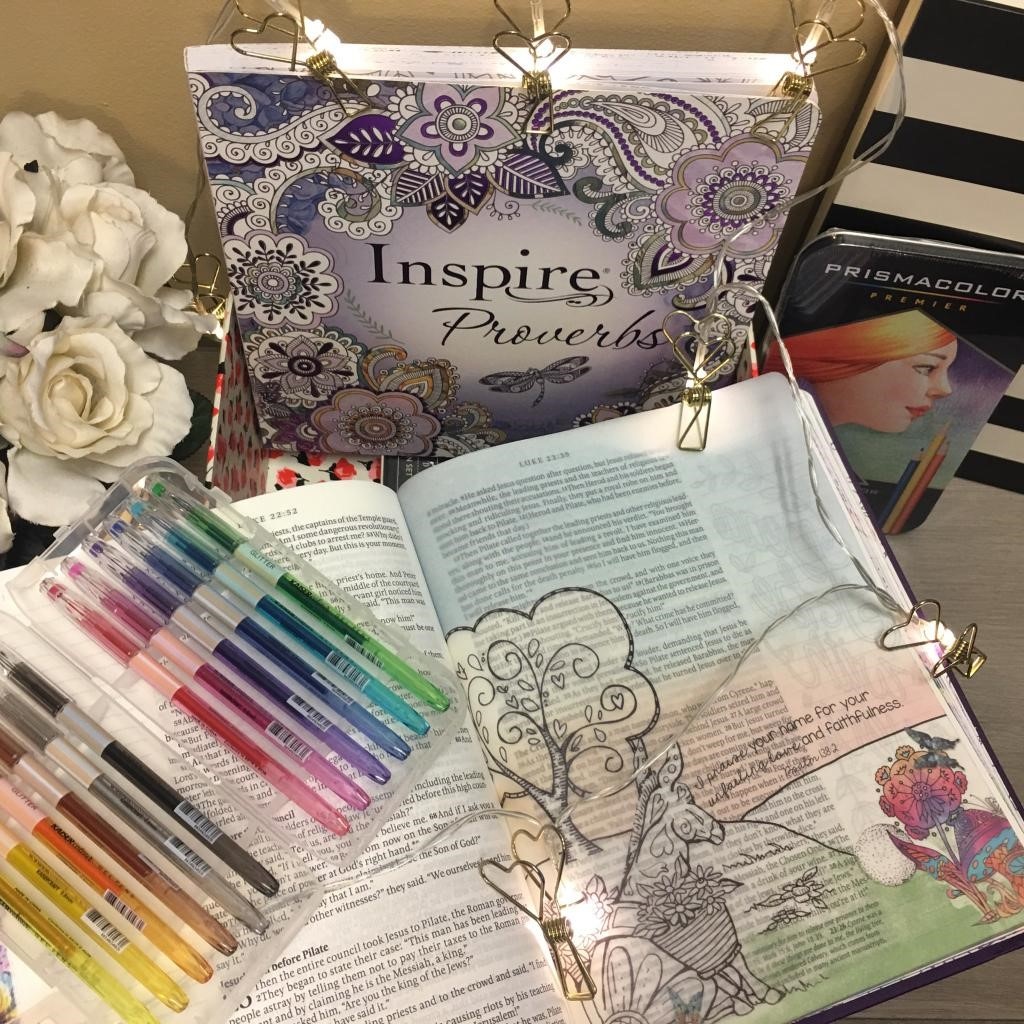
She walked up to theInspire Bible booth, touched the pages of my Bible, and looked up at me with wide-eyed wonder. “I didn’t know this is what I needed until just now.”
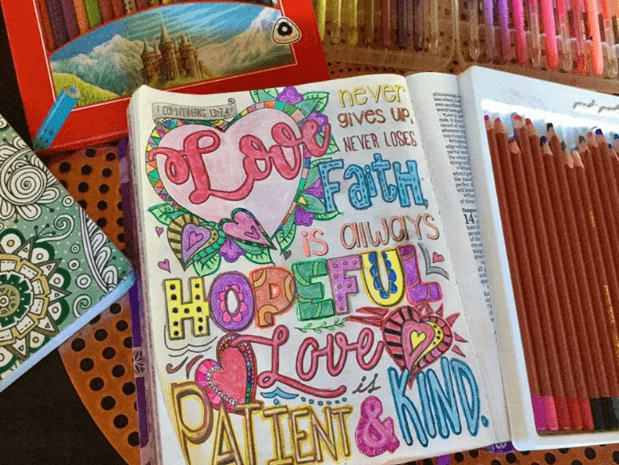
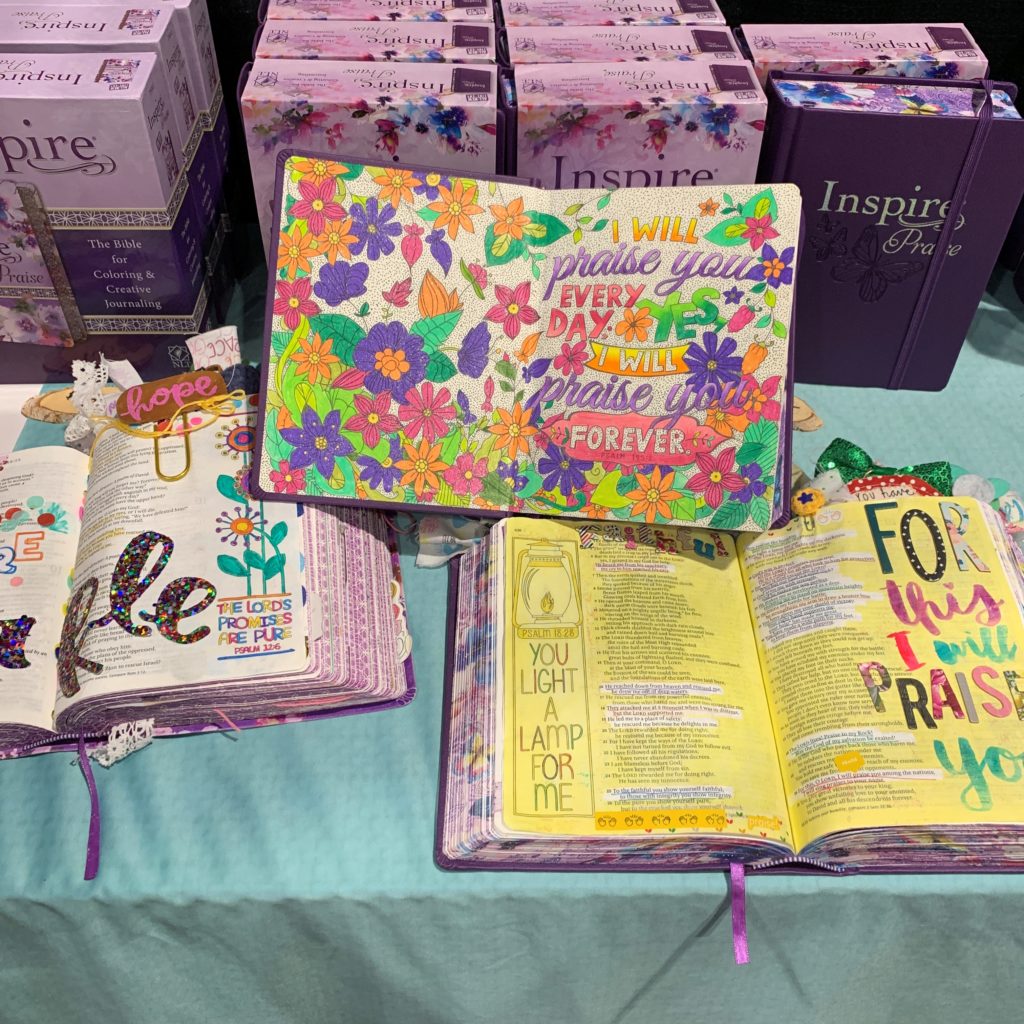
This year, in addition to the workshops hosted through churches and bookstores, the Inspire Bible TOUR has had a booth and a workshop at 12 Stamp and Scrapbook Expos across the US. We still have four more stops to go in Arizona, Colorado, and California. This new aspect of the TOUR has allowed us to share about the Inspire Bible and this beautiful way to respond to God’s Word through art in the margin with people who are already using their creativity for scrapbooking and card-making. Bible journaling is the perfect crossover, as it becomes a conduit of creativity to document faith. Over the past several years on the Inspire Bible TOUR I’ve enjoyed sharing about how Bible journaling is one of the ways we can study and respond to Scripture. It’s worship in the margin, it’s documenting a season of faith, and it becomes a legacy piece for decades to come.
So many curious creatives have stopped by the Inspire booth to ask questions, share their experiences, and begin their journey into creating worship in an Inspire Bible. Over the course of the past three years of leading Inspire Bible TOUR workshops, and especially at the Stamp and Scrapbook Expos, I’ve had so many questions and comments that I’d love to share with you because they might be some of the same things you are wondering. Here are some of the most popular questions:
So, this is a coloring book, right?
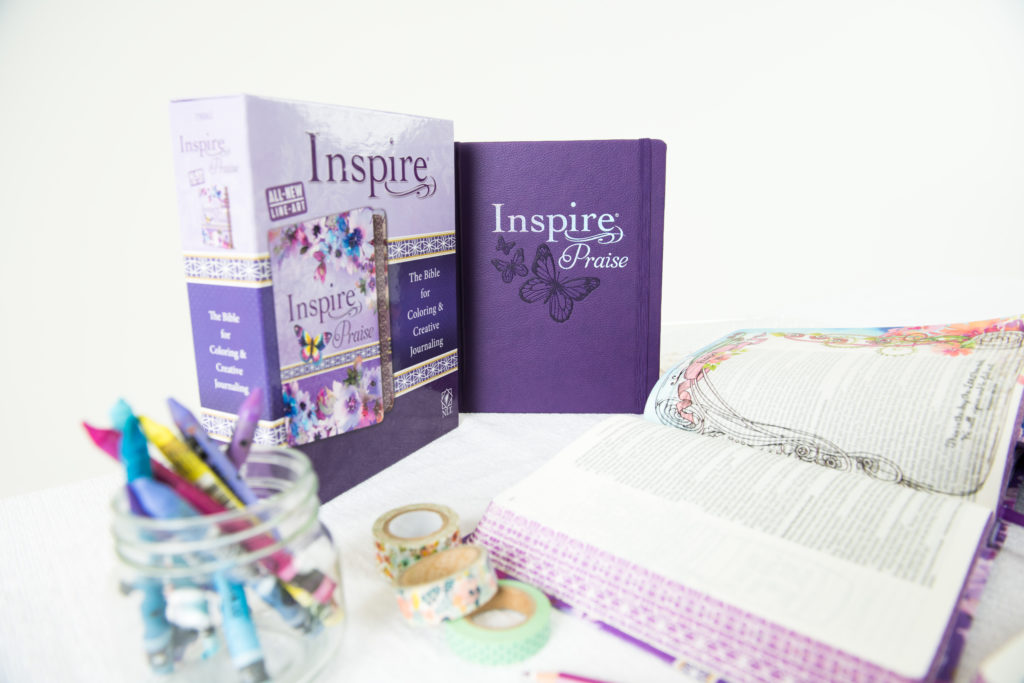
The Inspire Bible is a Bible. It’s the inspired Word of God. But . . . it has blank margin space, illustrations, and vellum inserts to help you respond to God’s Word. It’s the Bible first and foremost.
I’ve got so many craft
projects to do, I don’t need another thing.
When you sit down and spend time in the Bible, that time is
sacred. It’s not a craft project, it’s a study of God’s Word. It’s a chance to
come before the Lord and grow in your faith. We can approach Scripture with the
expectation that the Holy Spirit will speak to us as we read and reflect on the
inspired Word of God.
I’ve never done anything
like this before. How do I get started?
When I sit down and open my Inspire Bible, I focus on 4 things (pray, read, ask, respond). I open with prayer. I invite the Holy Spirit to challenge, encourage, and sharpen my faith. I then read a portion of Scripture. This seems obvious, but I admit, there are times I just want to color and not read the words. But because this is more than a coloring book, I keep the Word central. As I’m reading, I’m asking three questions: What stands out? What does this passage tell me about God? What does this passage tell me about how to live? THEN, I respond in the margin. I use the margin to answer one of those three questions. I keep it as simple as possible because I want to be able to read, respond in the margin, close my Bible and live out what I’ve learned! I want to be able to remember what I read and processed. It’s a life manual that invites you to respond with creativity in the margin.
I want to do this! What
specific Bible journaling supplies do I need?
Use what you already have and go from there. Most people believe you have to have specific art supplies for Bible journaling, but you don’t! You can use any of the stamp and scrapbook supplies you already have, even your children’s art supplies. You don’t have to break the bank to get started using the Inspire Bible.
I don’t want the ink to
bleed through to the other side of the page or shadow. So what should I use on
the Bible pages?
There are certain supplies that will bleed through the pages. While the pages of the Inspire Bible are thicker than traditional Bibles, alcohol-based inks will cause bleed-through. You can use gesso to prep your pages, but I personally don’t use it. I’m okay with a little bit of bleed through. I typically will just incorporate it into the illustration on the other side of the page. Many people buy an Inspire Bible but are afraid to start. They are stuck worrying about ruining the pages or not having the “right” supplies. Use the last few pages of the Inspire Bible (the index) to try out your art supplies and then JUST START. Once you get through your first few pages, your bravery will grow. Start to see your trip to the art store as a way to ask “Can I use this in my Bible?” Think outside the box. I’ve used nail polish, maps, napkins, Instax photos, and even a voting sticker in my Bible!
I can’t believe you would
write in a Bible. Why would you do that?
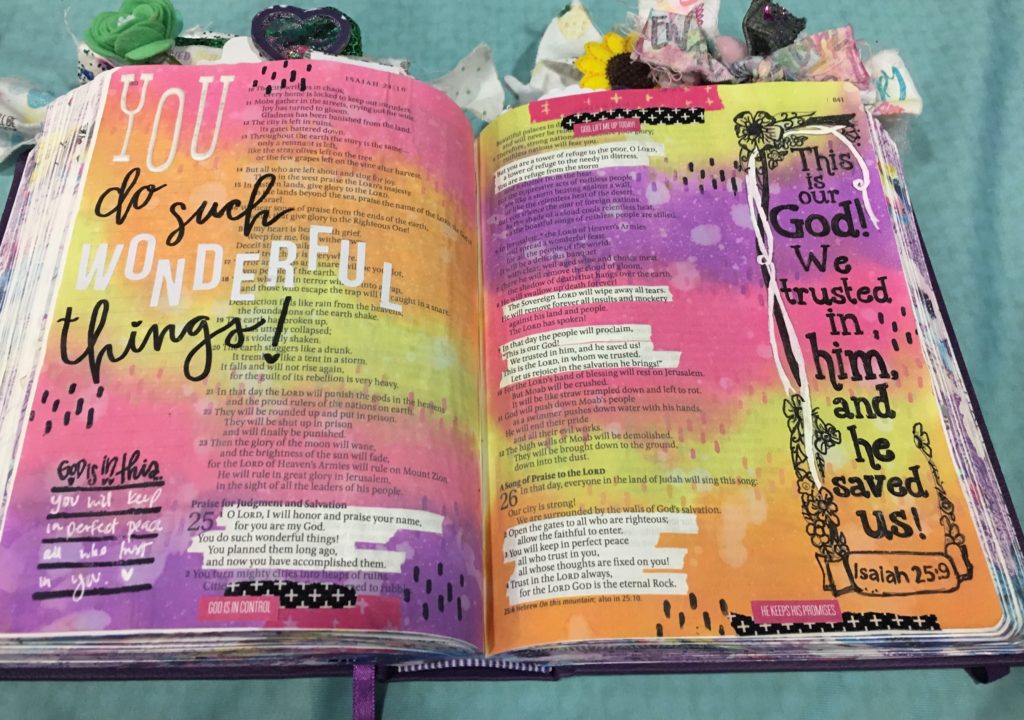
My Inspire Bible is my “art response Bible” not my everyday reading Bible. I keep one NLT Bible (it’s duct-taped and falling apart) that I don’t cover the words in. Everyone has what I call the “Spectrum of Coverability” level. On one side of the spectrum are those who would never write in a Bible, and on the other side is full coverage of art. Everyone has a particular level. For example, those who carry their Bible with them to church to use as their primary reading Bible will likely not want to cover the words. Ultimately, Bible journaling has been around since the Word was written. Kings and Queens would invite artists to depict stories in Scripture through art, especially for those who were unable to read. They even used stamps (carved in wood) and real gold to foil in the illustrations. Ultimately, the Inspire Bible was created so that you have margin space to write, journal, and create illustrations that help you visualize what you’ve learned.
Wow, I can’t create such
beautiful pages. You must be an artist, right?
I’m a Bible preacher, not an art teacher. We are all creative in
our own ways. Bible journaling is worship in the margin. Think of it as drawing
a picture and giving it to God, who turns and puts it on his refrigerator. He
is praised by our creative mess when we keep the Word central. Ultimately,
while my pages might be beautiful, I want my life to be a more beautiful
reflection of Christ based on what I’ve learned through Bible journaling. So,
don’t be concerned about the art; be more in tune to what the creativity is
cultivating in your heart. Are you being sharpened, challenged, and encouraged
by the Word? Is God honored by your time and creativity? These are questions I
ask myself to make sure my focus is less on “Instagram likes” and more on worshiping
the Lord.
We have just a few more stops on the Stamp and Scrapbook Expo schedule. Would you pray for those who walk by our booth or take the workshop? We’ve sold women their very first Bibles (ever), prayed with women who are battling heavy life situations who picked up an Inspire: Psalms, and engaged with moms and daughters about journaling in theInspire Biblefor Girlsduring their quality time together. We’ve seen people experience the Holy Spirit’s “aha” moments about getting creative for Christ and encouraged others who saw the Bible as intimidating to begin their journey to learn about God. People have even prayed for and encouraged us in the booth! Isn’t it amazing that God would put creativity in our hearts so that we can worship him? Let us live INSPIRED as we read and respond in the margins of our Bibles.
Taken from the Life Recovery Bible 12-Step Devotional for Step 6
“We were entirely ready to have God remove all defects of character.”
When we are upset, we often depend on our addictions to make us feel better. As we get rid of our addictions, we must face the deeper character defects that God wants to heal. Our addictions function as a place of “shelter” from our pain. But when that “shelter” is removed, deep anger may surface, exposing even deeper character flaws that need healing.
Jonah had a glaring defect of character: He couldn’t forgive and have compassion on the people of Nineveh, whom he hated. When God decided not to destroy them, Jonah threw a temper tantrum.
“The Lord replied, ‘Is it right for you to be angry about this?’ Then Jonah went out to the east side of the city. . . . And the Lord God arranged for a leafy plant to grow there, and soon it spread its broad leaves over Jonah’s head, shading him from the sun. . . . The next morning . . . the plant. . . withered away. And as the sun grew hot, God arranged for a scorching east wind to blow on Jonah. The sun beat down on his head until he grew faint and wished to die” (Jonah 4:4-8).
God did this to show Jonah that the real problem wasn’t the loss of his shelter. Hatred was the real problem. The removal of our sheltering addictions may expose deeper problems. This may spark defensive anger as God touches our deepest hurts. It is all right to let the anger out. But it is also important to let God take care of the real problem.